Last week, two of the most powerful AI labs on the planet both announced they were getting into professional services. OpenAI launched a $4 billion Deployment Company, acquired a consulting firm, and started embedding engineers directly inside client organisations. Anthropic launched an enterprise services company backed by Blackstone, Hellman & Friedman, and Goldman Sachs. In the same week.
That is not a coincidence. It is a thesis about where the value in enterprise AI actually lives — and it is not where most executives have been looking.
The model was never the hard part
OpenAI’s new unit deploys what it calls Forward Deployed Engineers — practitioners embedded inside client organisations to redesign workflows around AI systems. The $4 billion in backing came from 19 investment firms including TPG, Bain Capital, Brookfield, and SoftBank. To seed the unit with immediate capacity, OpenAI simultaneously acquired Tomoro, an applied AI consulting firm, adding approximately 150 deployment specialists from day one.
Anthropic’s parallel move targets mid-sized businesses. Its applied AI engineers will work alongside the new company’s team to identify use cases, build custom systems, and support customers over time — a long-cycle engagement model, not a product sale.
Both labs are making the same bet: that getting AI to work inside a real organisation is a professional services problem, not a software problem. The implication is direct. The model — the thing both labs have spent years and billions developing — is increasingly a commodity input. The configuration, integration, change management, and governance work is where the actual value concentrates.
Traditional system integrators have held that position for decades. Accenture, Deloitte, and their peers built multi-billion-dollar practices reselling enterprise software and managing the implementation complexity on behalf of clients. What OpenAI and Anthropic are signalling is that they intend to own that layer themselves — or at least take a significant share of it.
The ROI data enterprises don’t want to publish
While the labs were announcing their services arms, Gartner published a finding that should sit uncomfortable alongside most AI strategy decks currently circulating in boardrooms.
Approximately 80% of enterprises piloting autonomous business capabilities have reduced headcount. The workforce reduction rates among companies reporting high AI ROI and those with modest or negative outcomes were nearly identical. The cuts are happening. The returns are not following.
The companies with the highest AI gains used the technology for what Gartner calls people amplification — making workers more productive rather than replacing them. A second Gartner prediction sharpens the stakes further: 50% of enterprises without a people-centric AI strategy will lose their top AI talent by 2027. The practitioners who know how to make these systems work in production will leave for organisations that give them room to grow alongside the technology.
Across the technology sector, more than 92,000 workers have been laid off in 2026 through mid-May. Meta and Microsoft cut 20,000 jobs in April. Coinbase cited AI workflow consolidation for a 14% workforce reduction. PayPal plans to cut 20% of staff over two to three years. In most cases, the public attribution points to AI-driven efficiency. The Gartner data suggests the efficiency gains are not materialising at the rate the announcements imply.
What the labs understand that most enterprises don’t
The labs are not launching professional services businesses because they have spare engineering capacity. They are doing it because they can see, at scale, where their own products fail inside enterprise environments — and they understand that failure is structural, not technical.
Enterprise AI deployment fails at the integration layer. It fails when automated workflows don’t connect to core systems of record. It fails when governance is absent and agents proliferate without oversight — a problem Microsoft’s Agent 365, which went generally available in May, is explicitly designed to address. It fails when the workforce reduction narrative runs ahead of the change management required to make the new model work.
The Forward Deployed Engineer model is a direct response to this. You embed practitioners with the client, you redesign the workflow from the inside, and you carry accountability for the outcome rather than handing over a licence and a user guide. It is expensive. It does not scale like software. But it works in a way that self-service AI deployment, for complex enterprise environments, demonstrably does not.
What this means for enterprise IT leadership
Three things follow from this for anyone managing AI strategy in a large organisation.
The buy vs. build decision has a new variable. If the frontier labs are prepared to embed engineers inside your organisation, the question is no longer just whether to buy a platform or build on an API. It is whether to engage the lab directly as an implementation partner — and what that means for data governance, model dependency, and negotiating leverage over time.
The headcount-reduction narrative deserves more scrutiny than it is getting. Gartner’s data is not arguing that AI cannot generate efficiency gains. It is arguing that cutting people to fund AI, without a clear account of where the productivity improvement is going, is not a strategy — it is cost accounting dressed as transformation. The organisations generating real AI ROI are treating it as a capability multiplier, not a replacement programme.
Governance is no longer optional. Colorado’s AI Act takes effect June 30, 2026 — the first major US state law imposing requirements on algorithmic employment decisions, including impact assessments and employee notification obligations. Illinois has been in effect since January. The regulatory surface area for enterprise AI is expanding in real time, and compliance is now a core operational requirement, not a future consideration.
The signal in the timing
It is worth sitting with the fact that OpenAI and Anthropic made the same strategic move in the same week. Both read the same enterprise feedback. Both concluded that the deployment and integration problem is large enough, and sticky enough, to justify building a services capability from scratch — or acquiring one outright.
That is a clear message about where enterprise AI value is concentrating. The model is a commodity input. The configuration, integration, and governance work is the moat. Most enterprise AI strategies are still organised around the former. The labs just told you, with $4 billion and a press release, that the latter is what matters.
If this is relevant to where your organisation is in the AI journey, I share observations from the enterprise technology frontline regularly on LinkedIn. Connections and follows welcome.
This week, two of enterprise technology’s most powerful players made significant moves on AI agents. Microsoft launched Copilot Cowork. ServiceNow unveiled Autonomous Workforce and EmployeeWorks. Both announcements are real, both are significant — and both reveal something interesting about where the industry thinks it’s going.
Based on what they announced this week, I don’t think they’re being ambitious enough.
What Microsoft Did
Copilot Cowork shifts Microsoft’s AI ambition from generative to agentic. Until now, Copilot has been good at producing — drafting emails, summarising documents, generating slides. Useful, but fundamentally assistive. You still had to do the work.
Copilot Cowork is different. You describe the outcome. The AI creates a plan and executes it across your M365 environment — autonomously, across multiple applications, with you monitoring rather than doing.
That’s a meaningful line to cross. Microsoft is calling it “delegation.”
It’s currently in the Frontier programme — enterprise beta, not GA. The rollout will be careful. That’s very much by design.
Microsoft’s carefulness isn’t irrational. Their core enterprise value proposition is the security boundary. They’re trusted because they move deliberately, because they’ve earned the right to sit inside the compliance perimeter of some of the world’s most regulated organisations. Stability over pace is a defensible position — as long as their enterprise customers can afford the same.
That assumption is getting harder to hold. Agentic AI is not evolving on a slow enterprise adoption curve. Results are real, timelines are compressing, and competitors — both inside and outside the Microsoft ecosystem — are moving faster. Copilot Cowork is a meaningful step, but it’s structurally a one-shot: you define the task, the agent executes it, and the engagement ends. There’s no iteration loop, no mechanism for the agent to reflect on outcomes and sharpen its approach over time. For enterprise customers who can still afford patience, that’s fine. The question is how long that describes most of them.
What ServiceNow Did
ServiceNow’s announcement is, in some ways, more ambitious in its framing. They’re not calling these “AI assistants” or “copilots.” They’re calling them AI specialists — entities that own a job, end to end, the way a new team member would.
The stress test they cite is compelling: when Moveworks joined ServiceNow, their IT helpdesk load doubled overnight. AI absorbed 90% of L1 tickets without missing an SLA. They didn’t just survive the surge — they productised it.
That’s a real result, not a demo. And the language around it is unusually direct for a vendor announcement. “AI that finally clocks in.” “They own a job, not just a task.”
ServiceNow’s advantage is structural. They already own the workflow layer across HR, IT, procurement and finance in a huge chunk of enterprise. They’re not trying to build a new beachhead — they’re deepening something they already have. Adding intelligence to a layer that already touches every employee in every transaction.
That’s a strong position. The risk is that it’s also a constraining one.
ServiceNow’s frame is: make existing work smarter. Automate the ticket. Accelerate the process. Remove the friction from the workflow that’s already there. It’s a compelling efficiency argument, and the ROI is measurable. But a specific process is a narrow goal — and a narrow goal leaves no room for the agent to evolve, to find paths that look different from what you defined at the start. Like Microsoft, it’s a conservative deployment model. And it carries the same underlying assumption: that their enterprise customers have the luxury of thinking incrementally.
The Gap Neither Is Talking About
Both announcements are fundamentally about automation — replacing human effort inside existing processes with AI effort. That’s valuable. It’s also the conservative version of this opportunity.
What neither addresses is what happens when you give an agent a goal instead of a process.
A useful illustration: Oliver Henry gave an AI agent called Larry a single brief — grow his app’s TikTok presence. Not a content calendar. Not a process. An outcome. Larry executed Henry’s initial ideas, then started generating strategies Henry hadn’t considered — and they outperformed anything he would have done himself. Half a million views in five days, converting into paying subscribers.
The key was that Larry wasn’t constrained to Henry’s methods. Given a goal rather than a process, it found better work to do.
Apply that to enterprise support functions. HR, finance, legal, procurement — these exist in their current form as adaptations to human cognitive limits. Those constraints are shifting. If you hand an agent a goal rather than a workflow, you create conditions for it to find paths that look nothing like the current process. That’s a different kind of value than automation delivers.
What Microsoft and ServiceNow announced this week doesn’t go there — at least not publicly. The goal-oriented frame, where the agent challenges the process rather than executing it, isn’t part of the story yet.
Why It Matters Now
Microsoft and ServiceNow are setting the visible frontier of what enterprise AI looks like. That frontier will shape how executives think, how budgets get allocated, and how IT strategies get written for the next 18 months.
Both vendors are, rationally, optimising for stability. They’re large, their customers are large, and the cost of getting it wrong inside a regulated enterprise is high. Conservative deployment — narrow goals, one-shot execution — is a reasonable position for an organisation with that much to protect.
The risk isn’t that they’re wrong about their own constraints. It’s that they’re building platforms that impose those constraints on their customers too, without leaving a path to evolve inside the walls. As agentic AI matures faster than these platforms can absorb — delivering broader goals, iterating on outcomes, compounding over time — enterprise customers who want to keep pace will find themselves with one option: go outside the ecosystem.
That’s the disconnect. Not a competitive threat to Microsoft or ServiceNow, at least not yet. A strategic trap for their customers — built with the best of intentions.
The smart move is to ask both questions simultaneously: how do we make today’s work more efficient, and what does work look like if we give agents room to evolve it? The second question is harder. It’s also the one your platform may not be designed to answer.
Anders L. Munck is an IT executive and founder of IT Leadership Services, working with organisations navigating complexity and transformation.
Google just released their new NotebookLM experiement that turns your notes and websites into real conversations or spoken summaries. It may sound like just another fun toy, but having played around with it for the last few hrs, I can see a ton of usecases. Just getting a summary of all the articles I never got around to reading while bicycling to work would be a game-changer for me. In below, I asked it to make a podcast about my blog. Besides getting my name to somehow be “Lars” it was a great listen that fairly accurately and with a positive spin captured a lot of what is on there. I can’t wait to try it on other things. But play around yourself, and if you find other great ways to use it, please share. https://lnkd.in/dsKj47EY
As we rapidly cross Gartner’s peak of inflated expectations and navigate the fog of overhyped stories, it is time to brace for their trough of disillusionment. I’ve therefore tried to sort the facts from the hype by looking at the results of the last 12 months of research.
Before you read on, if you have a real interest in this area, please read the original papers and share observations. Any misinterpretations or omissions here are entirely my own, and we all get smarter faster by comparing notes.
Opportunities
In a recent working paper form Harvard Business School called “Navigating the Jagged Technological Frontier: Field Experimental Evidence of the Effects of AI on Knowledge Worker Productivity and Quality”, they compared the performance of 758 BCG consultants on 18 specific tasks to provide a baseline for comparing before and after.
The results showed that consultants using GPT-4 finished 12.2 % more tasks, 25.1% more quickly, and increased quality by 40%.
In another study of 95 developers by Microsoft and MIT, the results showed a 55.8% increase in productivity, and a third online study of 444 professionals, indicate a 37% faster completion rate on common tasks like minutes and memos, while also improving quality.
One of the conclusions of the BCG study, which seems to have been confirmed elsewhere as well, was that one of the biggest impacts of generative AI, was as a skill leveler. It allows lower performing employees to catch up. This is of course very tempting to employees, and as illustrated in this X (formerly known as Twitter) poll, the majority of employees may already be using it without necessarily telling anyone.
In short, the potential is very real, most of your employees probably already know and use it, but they may still be too shy to tell anyone.
Risks
The short-term risks may be obvious to most. Things like intellectual property rights, content fact-checking, or compliance concerns cause most to have a rather conservative approach to formal deployments. But with theeasyaccessto tools, and the promise of concrete personal performance improvements outlined above, it is hard to see how anyone can truly prevent it
The problem is that the value to the individual seems obvious, the limitations of generative AI are not obvious – for example, the ability to generate ideas is much better than calculating basic math – and although these gaps are rapidly evolving they are still large enough that any untrained employee can easily fall in.
In the BCG study, they call this the “jagged frontier” and to measure its impact, they split consultants into three groups, the first didn’t use GPT-4 at all, the second used it without training, and the third received training. While there were significant improvements in both groups using GPT-4, it was clear that variation in quality of work delivered by people without training was larger.
In this paper from Princeton University, they analyzed the impact of Generative AI on occupations, and conclude that among the most impacted will be the highly skilled and highly paid knowledge workers. Without training or policies in place, the risk is that the parts of your workforce most crucial to creating knowledge, will rapidly increase volume without necessarily increasing quality.
Longer term, this may limit opportunities. The content created today will become the source of the content we train our AI’s with tomorrow, and having to filter vast amounts of poor-quality AI-generated content could put a big dampener on things.
Business tactics
I’m sure everyone will have unique challenges and opportunities, and that the current rapid disruption will only make predictions harder. However, a few obvious tactics for dealing with the impact of generative AI stand out:
Allow multispeed adoption – Like with most disruptive technologies, businesses will have to adopt a multispeed adoption strategy. First, front-runners in low-risk areas will get to play, then a combination of larger groups or more risky areas will be added as experience grows.
Increase master-data scope – Employee-generated content is becoming a strategic resource, and each business will have to identify what content is critical to their core functions and start tightening the reigns to ensure quality at scale.
Let Workplace IT move in with HR – This has been true since Excel apps were the rage, but the need only increases every year: It really is time for Workplace IT, internal Communications and HR to become department buddies. The days of preventing employees from doing stupid things are long gone. To stay compliant you need to nudge, push, and train each individual to be able to take accountability for their own content, and to maximise opportunity you need to create a safe space for your front-runners to play.
Do nothing – I call this the “McKinsey option” as it is always in their slides. The go-to tactic for any CIO who feels they have enough on their plate, is to simply try to contain usage until the hype is over and the more certain benefits materialise. This is how most CIOs deal with technology innovation that doesn’t seem crucial to their core business.
Those are my five cents on this but let me know what I missed. As I said, we all get smarter faster when we share, and I’m sure I have a lot to learn.
By the way, when pasting the title of this article into Midjourney, this is what I got. Make of that what you will. Until then, see you out there.
The convergence phase of any new technology, where individual innovations are brought together to drive new use-cases, is usually where things become most interesting.
Recently, HeyGen labs released a beta of a video translation service that shows some of that potential. It is not flawless or live yet, but it shows some of what our future holds, and in that context, it is truly fascinating.
As I say in the video, “Imagine this in realtime, in online meetings, in customer support, with an LLM hooked into your internal documentation helping clients, teaching kids, helping patients.”
But let me know what you think of my new language skills. Am I passable, or still in beta?
Original text
“Hi language teachers from high school.
This is me again. The talkative guy with no sense of proper grammar that, as one teacher put it, “would probably get along in any language”
I’m back, but this time AI is helping me seemingly speak any language. I still can’t tell if my grammar is correct, but even if it is not, I’m sure it is just a matter of months before AI figures that out too.
Think of this in realtime. In online meetings. In customer support. With an LLM hooked into your internal documentation helping clients. Teaching kids. Helping patients. In any language.
Nobody knows where AI is taking us. We only know that it is going fast. The components are maturing every day. The convergence opportunities are multiplying.
You may not have an AI strategy today. You may not think you need one yet, and maybe you don’t.
But you will have one soon. Until then, I will practice my new language skills. Who knows that they might be useful for.”
Summer vacation is coming. My family and I are halfway out the door to explore a new part of the world, but before I go, here is a short article from our Work Smarter series that will hopefully help those of you still struggling at the office to stay sane.
There are few things that induce stress as much as interruptions. Whether it’s kids, annoying alarm-clocks, or friendly colleagues, getting interrupted is one of the primary stress factors at work, and wastes as much as 581 hrs of our busy lives each year.
But it’s not as simple as that. As social creatures, being in a setting with other people also reduces stress, and it’s therefore not so much a question of avoiding interruptions altogether, but of controlling when interruptions happen so we can minimize their negative effects.
Understand your work modes
We all have different modes of work that we switch between during the day. Although you may not notice it, even our offices are often designed around work modes, to support a healthy work-environment.
There are variations on how people define these work modes, but I find the following to be the most helpful:
Focused – You need to deep dive into something on your own. No distractions, no messages.
Available – You are working individually, but available for contact with others, checking mail, and chatting with coworkers.
Engaged – You are in active synchronous interaction with a specific group of people in a meeting, brainstorm, or group chat.
Resetting – You are clearing your head and relaxing to make space for the next task. Either alone or with colleagues.
As you may have spotted, a lot of this is about managing the balance between momentum and agility.
When we are focused or engaged, and then suddenly interrupted, we lose momentum. We waste valuable time getting back into the groove again and if it happens regularly, we get frustrated and stressed.
When we are available, we are mentally agile. We are open to inspiration and inspired by interruptions. We actively seek out colleagues to “hang out with” and share our thoughts and feelings.
When we are resetting, some people prefer being with other people and others prefer solitude. In both cases the principle is the same, we need to control interruptions to get full value of our time.
This is why knowing your work modes, and controlling when interruptions happen, is crucial to a better workday.
Control interruptions
There are many practical things we can do to control when interruptions can happen.
At the office
Offices have areas that are designed for specific work modes.
The desk area is supposed to be a focus zone, but in open offices, this is often not respected or hard to achieve. If so, get a big headset with anti-noise, move temporarily to a different location, use the cafeteria, or take a day working from home.
The the open areas, like coffee islands, cafeteria, or soft furniture, are for being available or resetting. If you prefer to reset in solitude, take a walk around the office or a short walk.
The meeting rooms are designed for engaging with others. You can use the open areas in a pinch, but please respect that an impromptu meeting or brainstorm should not happen at the desks.
On your phone or workstation
Most platforms have tools for preventing interruptions. On Android it is called Focus mode, on iPhone/iPad it is called Focus, on Windows 10 there is Focus Assist and on Mac it is also called Focus. Use this actively to avoid interruptions.
In Microsoft Outlook, turn off notifications on new messages to avoid getting disturbed unnecessarily. This will not influence meeting reminders, which are actually useful.
These are just a few of the things you can do to control interruptions and reduce the noise for yourself. However, creating a great workplace experience is not just about individuals, but about all of us working smarter together.
Reduce the noise
Here are a few small habits, that will help both yourself and everyone else keep the noise down in the Workplace:
Keep your phone on mute, permanently – A ringing phone is invasive to everyone around you. Picking up a voice and video call is even more disruptive. Keep it on mute and don’t feel the need to answer instantly. Instead, schedule time for checking unanswered calls.
Use chat as much as possible – Chat is the least disruptive and most effective form of communication we have. Initiate one-to-one conversations with a chat message, ask your question directly to save time, ask for 5 mins if you need to talk, etc.
Replace meetings with group chats – Group chats are like meetings but require less focus and are more effective. You can contribute when it makes sense, leave when it is irrelevant and come back when needed. You also keep a main thread of everything that has been said automatically.
Avoid emails as much as possible – Emails allow you to “park your ideas and send them away”, but you force everyone to then have to decipher them, deal with the fragments of people replying to subsets of people. The total noise created is completely disproportionate to the benefit you get. So don’t send mails unless you need a formal record, and don’t read them when they arrive. Schedule a half hour to “check emails” in your calendar every day instead.
Don’t talk around desks – If you need to talk to someone, ask for 5 mins and step away, and if that is not an option, sit down and talk quietly. You can have online meetings at desks but try to keep you voice down and if it’s you are presenting, book a room. Think of desks like a library. People are generally trying to read or write there.
Use texts for emergency alerts – Phone texts are old fashioned and invade your private life, but they are short, easy to read, and therefore a lot less disruptive. So, when speed is key, use a good old-fashioned text.
These are just a few small habits that will reduce noise for everyone. Finding smarter ways to work together is an ongoing process that we are all involved in, so what do you do, to reduce the noise in your life?
Let me know in the comments below or reach out directly. I’m always interested in learning more.
Having spent over ten years in the digital trenches of corporate multinationals, and most of those in positions with copious opportunities for having to live with my own decisions, I’ve learned a lot of valuable lessons.
The first and most important one is that there are no cookie-cutter solutions. It may seem enticingly simple at that first presentation where the sparkly-eyed consultant shares his sense-of-urgency and resolution slides. Get a digital team together, drive a startup culture, be agile, start a few Tribes or Circles. Before you know it, you’ll be plowing full steam ahead on awesome transformative ideas with the wind in your hair and competitors at your back.
The truth is not as simple. Most companies of 40.000+ employees don’t work like startups. They have the inertia of seemingly endless dependencies, legacy-systems, opinions, and legal obligations, that drive most digital VP’s to isolate Digital. Build a separate new culture, jerry-rig it on top of the old, and see what rubs off.
The problem is that this approach doesn’t leverage the existing organization at all. The outcomes are often generic ideas that any outside consultants could have come up with. Maybe a product or two will take off, but unless you’re fortunate and they make more money than your core business, it will be a short-term and isolated success that doesn’t lift the end-to-end value chain much.
For real company-spanning digital transformation, you need to combine the two. Create the necessary space for agility and innovation to grow, in a way that incorporates and leverages the hard-earned skills and experience of the employees.
In the following, I will delineate a few of the core actions needed to make that happen.
Agility at scale
Being agile at scale is hard. SAFe does wonders if your primary purpose in life is building the one software suite to rule them all, but not all enterprises are that lucky. Most of them are in the aging, and decidedly uncool business of selling physical products, having legacy technology they can’t get rid of, and so anti-hipster that they insist on keeping their less-than-carbon-neutral production sites running.
Hiring a digital VP and bringing on a slew of digital initiatives, while building a new and agile organization on top of the old, may excite investors, but it isn’t a solution. Enterprise IT feels cumbersome because, on a certain level, it needs to be. Building something new on top without incorporating that need, just delays the problem.
It leaves IT between the rock of executives wanting digital to happen quickly, and the hard place of bearded youths excitedly throwing half-done products “over the wall.” It leaves organizations dichotic, spending too much effort on internal pressures to react to the external dynamics that they are there to address.
Rebuilding a train while running it at full speed is no simple task, but you can be smart about it. Agility isn’t about how fast you can develop something, but about how soon you can get new ideas into people’s hands. The value of agility doesn’t come from being able to say “pretotyping a UX” quickly or being able to deliver a one-weekend hackathon, but from how fast you can have a working solution in the hands of everybody.
Agility is built from the ground up. It comes from thinking ahead. From carefully stacking the cards in favour of responsiveness. Not everywhere, but where it is needed. It sounds counterintuitive, it is definitely not cool or hipster, but it’s the truth and everybody knows it.
Take AI as an example. Creating a one-off ML solution that will dazzle top management is relatively easy. At least if you know your way beyond the standard chatbots and RPA tools.
Take that same AI solution and put it in the hands of ten of your friends, and it may work fine. But reach twenty (or annoying uncle Ben with the big thumbs), and your developer will give you that dreaded “but it works on MY computer,” someone will point out that the data you’re using is violating GDPR legislation, or you’ll hit a new requirement that forces you to start over.
The inevitable party-pooper moment. We’ve all been there. You need to stack those cards towards agility.
The first and classic step is layering. Frank Duffy introduced shearing layers in the ’90s as a way to think about buildings aging at multiple speeds, and Gartner reintroduced it as PACE to address how different layers of technology should be able to evolve at different speeds and still work together.
Thinking of your enterprise application stack as layers working together at different speeds, with your innovative platforms at the top, is a significant first step, but it will only give you flexibility. It will not make you agile.
I’ll never forget the launch of one particular “innovation enterprise framework” built on these principles. There were so many hoops to jump through to get a simple server running, that I wouldn’t wish it on circus animals, but it did get us to where we could at least get data safely out of the back-end. As a first step, that is quite significant.
The second step is a proactive service design. You won’t find this in theory books, but most CIOs will have some version of it in their playbook.
Predict what technologies will be essential to innovation in 1–2 years and build up the capabilities to deliver on them before anyone knows they need them. That may sound far fetched, but it’s not rocket science.
I just spent three months of my spare time working with one of the leading enterprise AI companies in Denmark. I helped them build their new go-to-market and communication strategy, and they showed me all about the opportunities and governance pitfalls of enterprise AI.
Why? Because it’s been fairly obvious for a long time that AI will play a key role in future digital transformation, and I didn’t want to get stuck delivering data-lakes, AI scaling, and other things requested right now.
I wanted to get ahead of that curve. I wanted to understand how to build AI service layers with native data compliance at scale. I wanted to start preparing automated product-recognition, customer purpose analysis, and other core services of the future before I’m asked for it.
This is the first real step towards true enterprise agility, set yourself up to be able to deliver 80% of a solution in 1% of the time and cost by looking at where the ball will be instead of where it is.
For inspiration, take a look at how Amazon built up hosting and data capabilities to be modular while they were still only an online bookstore. From a strictly “get the books out there quickly”-perspective, it didn’t make a lot of sense, but from a “prepare to add services once we get new ideas,” it was the difference between Netflix and Pets.com.
The third and most crucial step is to stop looking at hammers and start looking at nails. Some years ago, our Communications VP got involved in building a new “social intranet” with our Digital team. They spent a year, two-digit million, and I don’t know how many worn-down developer keyboards creating the “next big thing.”
She wasn’t impressed. Even less so when I had the head of my SharePoint Online team build her the same solution using standard components, migrate all of their content, and make it look a lot better in the meeting while we were still discussing the solution she had received.
There is no guarantee that SharePoint was the right solution, but it was 80% of the solution, in less 1% of the time and cost, and on a platform that could scale. Starting there would have given them back 99% of their budget and time to built something genuinely innovative rather than just replicating what already existed.
The challenge here is that most digital departments come from startup culture. They’re used to grabbing a few cloud-servers and code away. They’re not used to an enterprise environment that already has tons of capabilities and opportunities to help them move faster or more quickly than any startup ever could.
To avoid missing those opportunities, you need to bridge Digital and IT. You need to get all your brains in the room and not just the ones with beards and sneakers. Sure, you can have separate innovation floors with lounge-chairs, whiteboard walls, and baristas, but don’t have them be where Digital sits. Have them be shared floors, where you get everybody together, and work out what to do about each nail. Maybe you don’t even need nails?
I know that having the guys stomping on the speeder in the same room as the people camping on the brakes is a tough sell. But do the effort to bridge the gap, prepare the technologies you need in advance and you’ll find that enterprise agility can be a lot faster and more effective than even your most impatient sales exec expects.
Enterprise agility may sound far-fetched, but it is not. Build your application stack to be flexible, invest in the technologies you’ll need early, and don’t isolate digital activities in one department. You’ll find that agility at scale isn’t just possible. It is also a lot more fun and effective than what you do today.
TL;DR — Being agile at an enterprise scale isn’t an oxymoron. It requires that you get comfortable running your business at multiple speeds, anticipate what technologies will be needed, and don’t isolate anyone from the process.
Part 2
This article is the second in a series of three. Feel free to read them together, separately, or skip to the TL;DR summary at the end of each.
Innovation at scale
Digital disruption is real, and enterprises need to innovate to survive. Sure, but as most of us have quickly realized, innovating at scale in a line of business where your revenue is almost entirely based on your ability to run existing core services is a tough job.
On the one hand, building a digital department as a separate unit with a fail-fast culture may be a safe approach from a cost perspective, but from a value-perspective, it doesn’t have enough impact. As Microsoft realized almost twenty years ago when they decided on their Cloud strategy, impactful innovation happens at eye level. It needs to be in people’s hands in weeks rather than years.
On the other hand, transforming your entire organization into tribes blissfully kan-banning their way through hyper-automation and connected retail projects runs a high risk of just confusing everyone. No matter the excitement level of your Digital VP, there is truly no sadder sight than a group of blank-faced execs leaving their hard-earned experience in the dust, throwing buzzwords around, and trying to avoid standing out as the too black-hat legacy one of the bunch.
To be honest, tribes confuse me too. Historically, tribes are insulated at vast distances, rarely interacting. How can that be a recipe for innovating a business? But I digress, back on point.
The point is that business innovation is not new. Digital has added opportunities that can be highly disruptive and hard to grasp, but at its core, it is no different from Heinz putting ketchup in a glass-bottle more than a hundred years ago. Instead of his competitors’ gooey brown substance in a dark pot, he used a glass bottle, so the red color beneath became visible. He put a label on the neck to hide the brown surface it had before vacuum sealing and delivered a beautiful red sauce that changed the game. Great product, game-changing experience.
When Sony launched the WH-1000XM3’s, which combined smart controls, audiophile sound, and discreet looks, it didn’t matter that nobody could pronounce the name. It was the first headphones to be both good quality AND smart, and it brought them right to the forefront of that market. Great product, game-changing experience.
Have a business selling beverages from vans in New York? Don’t waste money on an app so people can find your vans. Why would they? Make a deal with a running app, consolidate their data with your route-planning, and put your vans where people are. Great product, game-changing experience.
And not just on the external ground-shaking level. Early in my career, an intranet search engine had somehow garnered the ire of top management. The search page took two seconds to start loading and would break if you pushed the button twice, which everybody did — a lot.
No amount of costly developers could remove those two seconds delay, but a smart front-end developer put a small box on the page that would pop up the moment you pushed the button. It just said “searching…”. After that, the search engine was “fixed” without having changed at all. Again, all about the experience.
What Heinz, Gates, Jobs, Bezos, and everyone else who has ever excelled at this has amply demonstrated, is that the product can be outstanding, but the company providing the more compelling experience will win. Digital gives us great opportunities for reinventing that experience, but if you’re not lucky enough to have one of those true digital visionaries at the helm, make do with what you have.
The best card you have for building digital innovation at scale is the hard-earned experience of your existing organization. So instead of confusing them or hiding from them, make them active participants, and your innovation will reach new levels.
The first part of building an innovative culture is to create awareness of the outside-in experience. I’m amazed at how few organizations ask employees to spend one day every year in their customers’ shoes. Not just externally, but internally as well. Have IT employees spend a day in HR, have HR spend a day in sales, have salespeople spend a day with a customer. Have them mix it up and come back to share their findings with their colleagues.
Even without digital being a factor, you’ll see innovative ideas pop-up across the board, priorities reshuffling towards better use of people’s time, and better cohesion across units.
As one sales-exec once told me after she realized we spent six weeks clearing a new customer before sending them any brand materials or products: “This is just silly.”
Taking the outside-in view is that uncomfortable but necessary step outside your comfort zone, where you face your own idiosyncrasies. It’s when you stop focusing on improving what you do, and start focusing on what needs to be done.
The second part of building innovation at scale is to create digital competence, not just in an isolated team, but as part of the corporate culture. Everybody doesn’t have to be an expert. Present what is possible. Present what others are doing. Present what we are doing. Show all the cool things happening out there. Inspire people. You may create unrealistic expectations here and there. Still, the foundation of the ideas coming in will be sounder and more impactful than anything six ex-digital bureau people with a whiteboard and lounge chairs can imagine. No matter how much time you give them.
Not that those guys don’t have a place in the process. They do. They are the ones that do the inspiration and will have to do the filtering and transform the ideas into realistic product proposals. They are the ones providing input for the technology roadmap and the overall innovation plan that looks years into the future for what capabilities needs to be built up to succeed long-term.
The point is that digital innovation at scale requires everyone. Not just digital people. Everyone. If you succeed in that, the impact will be on a completely different level.
TL;DR Innovation requires the ability to take the outside-in perspective. Promote that perspective by forcing people out of their c
Part 3
This article is the third in a series of three. Feel free to read them together, separately, or skip to the TL;DR summary at the end of each.
Cost and compliance at scale
At one company I worked at, we once had a genuinely impactful role that I was lucky enough to hold for almost three years. We called it a “Product Manager,” but if you know modern frameworks, you wouldn’t recognize it. Instead of owning the user-experience or have any kind of engineering input, I owned a domain of products as part Enterprise Architect and part budget-accountable.
In other words, I didn’t just own the strategy and roadmap; I didn’t just oversee project costs; I was also accountable for the running costs and the value I’d promised to deliver. There were no easy ways out. All bucks stopped at my desk. Any misguided optimism on my part and it would land right back on my table.
It may sound terrible, but it was awesome. Working in a 40.000+ employee company, this was the first time I had a chance to build a complete end-to-end overview of my value-chain and could see the impacts up and down the line. My domain was “everything not-ERP related,” and among other things, it allowed me to build the business case for what would become the first large-scale roll-out of Office 365 in Europe.
The details of that project are for another time, but it gave me a unique insight into the challenges of retaining cost and value ownership in large organizations. Particularly in a domain where local innovation and self-governance were rampant way earlier than in other areas. Anyone who remembers the craze of self-developed Access apps will know what I mean.
Now that everyone with a company credit-card can launch a sophisticated company IT service — in about the time it takes a gourmet coffee-machine to finish a Latte and at about the same price — that problem has escalated. Not least, because that service may cost the same as a Latte to launch, but costs escalate at a rate of per-user-per-month, the service doesn’t integrate with anything else, and it typically has opaque terms of use that nobody reads.
Scale that up, and couple it with GDPR and the need to innovate, and you have an issue that can quickly undermine any digital transformation. The sheer volume of noise from competing apps, solutions, services, ideas that keep popping up throughout departments and affiliates, and the risk they entail is enough to overwhelm anyone. You get an organization that is mired in internal governance instead of transforming.
The core issue is that large organizations have big accountability-distances. There is too far between the people spending money and the people earning it. Too far between the people taking risks and the people affected by them.
Having learned from the initial Dot-com bust, modern startups are usually too small and too well managed for this to be a real issue. However, add a “digital initiative” in a multinational organization with a carte blanche to “do something,” and the risk of things escalating becomes much higher.
The key is to close the distance between cause and effect. Maybe not into one person, like we did with our custom “product manager” role, but at least enough that people start to see the potential impact of their actions.
Instead of just having employee policies, bring in tools that monitor internet-traffic and warn people if they’re doing something stupid. If that excellent free web-based Image editor they just started using, have terms-of-use that hand over IP rights for all uploaded media, give them a heads up. Don’t just rely on group-wide audits and reading the riot act.
Instead of having central license costs, start reporting them per division, per department, and maybe even per person if legal allows it. Show people and managers what they spend. Of course, you can’t do that with all IT costs or even all licenses, but that is not the point. The point is to nudge people. To show them enough that they start making smarter decisions on their own.
The ability to control cost and risk centrally went out of the window with internet-services, portable apps, and mobile app stores. You no longer have a security perimeter for your company. You have one in your data center, on personal devices, and in the minds of each employee.
To retain control of cost and risk at scale, you, therefore, need to leverage that people are by large good-intentioned. People do not want to damage their company. They are making the best decisions they can with the information they have.
Providing that information promotes better decisions and is by far the most effective way to avoid governance overload that would otherwise drown your digital transformation.
TL;DR — Cost and compliance at scale are no longer possible as strictly central activities. You need to nudge your employees by giving them the right information at the right time.
Final words
This series is not the definitive word on Digital Transformation. It is merely a primer. A few valuable lessons to show that Digital is doable at scale and even in very complex organizations. That although complex to achieve, the core tenets are not as complicated as some pundits will have us believe.
Digital transformation is here. It is happening now, and by sharing a few of the things I’ve learned dealing with it on a daily basis, I hope you may find a bit of inspiration to help you move forward faster and with a bit more peace of mind.
If not, I hope you at least liked the painted rocks I used for illustrations. They may not be pretty, but they were a lot of fun to make.
As most other companies we’re battling a combination of attention fatigue and generational gaps in Carlsberg. This makes it almost impossible to communicate new concepts and push the organization in new directions. We therefore want to create ways of communicating that gives people maximum value with minimal effort.
One concept we’ve been testing recently is called Smarter in 60 Seconds. It is a simplified way of training people on one specific subject that combines four components:
One three minute introduction video with four components:
What it is
Why it is important to Carlsberg
Why it is important to you
How you get started
Several 60 second videos showing how to do one specific thing that you are likely to find useful and share with others
Articles combining two or more videos, with with step-by-step recap guides, showing you how to do more advanced things
Monitored forum where our experts will answer any questions, and use them to create better guides
The benefit of these short videos is that they are easy to update and use in different contexts. As an example, several of them have been used in articles on our global intranet, or as posts in our social channels.
Examples
Here are a few examples of training we’ve done using this concept. The examples are from different training subjects, so don’t let that confuse you:
Three minute introduction video (from Artificial intelligence training):
Sixty second training video showing how to achieve one thing that you are likely to find useful and share (from Outlook training):
Article combining two or more videos with step by step guides (from SharePoint Records management training)
Feel free to copy this concept in your own company, and let me know how it goes in comments or on Twitter.
A lot of our non-tech colleagues have a hard time wrapping their heads around what Office 365 is, so we’ve tried distributing the Office 365 Periodic Table in Carlsberg, but it doesn’t seem to work as well as we’d hoped.
I have therefore come up with the two drafts below. Goal is to make illustrations that are simple enough for anybody to grasp, and detailed enough for the rest of us to get some value of.
Any input (or corrections, which I’m sure are needed) would be more than welcome.
I recently did a presentation of our 15-year intranet and website journey in Carlsberg to a number of our peers.
With 70+ websites and intranets managed across 30 markets on pretty much a shoe-string, we’re an interesting case on how much can be achieved with very little.
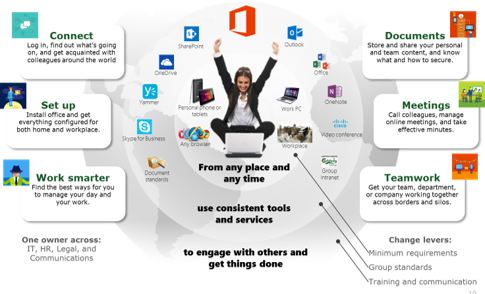
However, at the end I shared my vision of a holistic workplace, where intranets, mobile devices, and even the furniture and layout of our buildings themselves were parts of one holistic vision of how we see our employees work and live in the future, and noticed a change in the audience.
Most people, probably just ignoring the starry-eyed hullabaloo, seemed fine with my expanding perspective, but there was a distinct glazing over of eyes and a few reviews noted that my ending was a bit over-the-top and naively optimistic.
I agree, actually.
But I also firmly believe that this kind of starry-eyed thinking is necessary. It’s not just necessary because “reaching for the stars, will at least get you off the ground”, but because a holistic perspective, no matter how vague or ambitious, is needed for everything else to make sense to people. Building strategies for a single well-defined technology-area at a time will get you great technology, but will not move the enterprise.
An Intranet strategy cannot stand alone, but has to be anchored in an idea about how people come to work and use it as part of their personal life and the corporate culture. If not, it will just become an enforced startup page where people read the People News.
A mobile device or PC strategy cannot stand alone, but has to be thought into meeting-rooms, desktops, App strategies, and leverage the habits of both techno-fobes and techno-fanatics to deliver positive change in their day-to-day workflows.
The same goes for workplace design, cafeterias, social collaboration, car, etc. I’ve seen too many well-meaning renewal projects grind to a halt or have little or no impact, because they only focused on one piece of the puzzle and ignored the big picture.
Obviously we’ll never know enough to have a perfect 20-20 vision of the future, but a clear vision of what we think it’ll be, no matter how ambitious or abstract, adds a level of direction that gives meaning and add value beyond what can be achieved by individual projects or areas.
This is how you build an enterprise. Not just by building the best components and solutions in the world, but by thinking them into a vision of what you believe will happen. Even if that future is always uncertain and your vision therefore sounds a bit far-fetched and naive.