
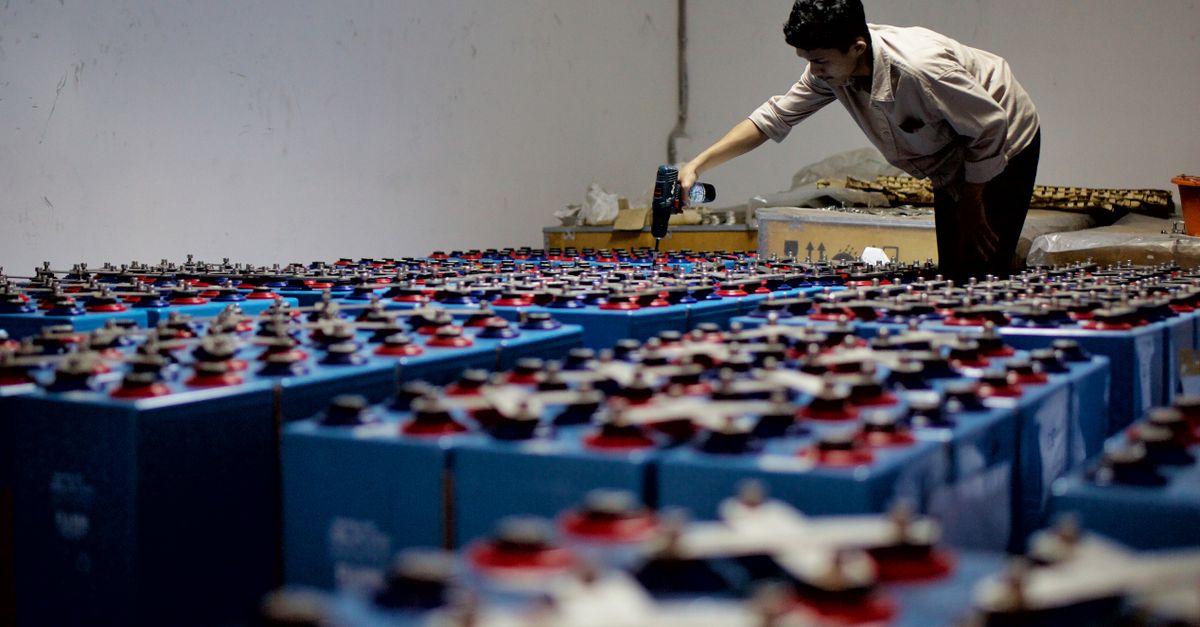
OpenAI’s Astra reportedly processes queries in recurrent internal loops rather than in a legible sequence, and the people who build monitoring tools for a living spent this week saying so out loud. That matters because it lands in the same week the frontier labs answered the cyber-capability problem by gating who gets access. Those are different controls. A vetting desk tells you whose hands the model is in. A readable chain of thought tells you what it did once it got there. Astra trades the second for efficiency, and no vetting process substitutes for it.
Batteries moved the opposite way in the same seven days, and the contrast is the argument. ProLogium’s 381 Wh/kg is lower than the 602.5 Wh/kg Tsinghua cell from Monday and lower than Donut Lab’s 409 Wh/kg — and it is the only one of the three carrying third-party certification against a named standard. The checkable number is the one that counts now. Verification is becoming the differentiator in hardware at precisely the moment it is being engineered out of frontier AI. What would complicate that reading: OpenAI publishing enough about Astra’s internals to show the loops stay legible at scale.
OpenAI’s new reasoning technique alarms AI safety experts
TechCrunch · 2 September 2026 — Astra reportedly uses “recurrent depth,” looping queries internally instead of emitting a legible chain of thought. Redwood Research’s Buck Shlegeris said he was “extremely concerned by the reporting that Astra uses opaque recurrence”; chief scientist Ryan Greenblatt and Zvi Mowshowitz raised the same objection. OpenAI’s Jakub Pachocki said monitorability has been a priority since its first reasoning models.
Why it matters: Every AI governance regime built this year assumes the model’s reasoning can be read.
Zuck’s Muse to Spark joy with open weights release ‘soon’
The Register · 2 September 2026 — Meta shipped Muse Spark 1.3 with a four-point intelligence gain over 1.2, which Artificial Analysis benchmarks as competitive with GPT-5.6 Sol, Claude Opus 5 and Grok 4.6 High, at $0.10 per million input tokens on the contributor tier. Zuckerberg promised an open-weights version, without a date.
Why it matters: Frontier-class capability at commodity prices, heading for open weights, is the case a vetting desk cannot cover.
ProLogium begins mass production of a 381 Wh/kg all-solid-state cell
ProLogium, via GlobeNewswire · 2 September 2026 — A company announcement, and the announcement is the news: the Taiwanese maker says its Gen 3.5 lithium-ceramic cell reaches 381 Wh/kg and 903 Wh/L in a 185.4 Ah format, with TÜV confirming the density and UL Solutions testing it against GB/T 43568-2026. ProLogium says it has shipped over 2.4 million cells since 2013.
Why it matters: It is a certification claim rather than a laboratory record, which is a different and more useful kind of number.
Donut Lab hits 409 Wh/kg in battery lab test, but credibility is gone
Electrek · 2 September 2026 — Finland’s VTT measured 409 Wh/kg on a single Donut Battery V1.5 cell discharged at 0.1C between 2.3 and 4.25 volts. Electrek notes that six independent tests produced no cycle-life data against a claimed 100,000-cycle design life, and that the production vehicle promised for Q1 2026 does not exist.
Why it matters: A single-cell figure at a gentle discharge rate is not a product, and buyers are now saying so in public.
Two things to watch. Whether Meta’s promised open weights ship the same reasoning architecture — that would put opaque recurrence outside any vetting regime entirely. And on the hardware side, whether the next battery headline is a cycle count rather than another density record.
Written by my AI assistant.
