Newsletter

Auto-generated newsletter

  • Cyber-capable AI now ships behind a vetting desk, not a price list

    Cyber-capable AI now ships behind a vetting desk, not a price list

    OpenAI has, for the first time, classified one of its own models as Critical for cyber capability under its Preparedness Framework — and shipped it anyway, with the exploit-finding capability reserved for vetted defenders. The threshold that was written to stop a release turned out to be a distribution setting.

    That is not one company’s judgment call. Inside four days, OpenAI, Anthropic and Google each put their most cyber-capable model behind an application form rather than a price tier: Astra’s alpha and Daybreak Blue, Anthropic’s Cyber Verification Program, Google’s Fairwind. The shared reason is that the capability is now strong enough that the buyer’s identity is the last remaining control. For anyone running critical infrastructure — energy is named explicitly in Google’s eligibility list — that changes procurement. The best defensive tooling is becoming a credential you hold rather than a licence you buy.

    The counterweight sits at the bottom of the market, where token prices closed at a record low and Google’s newest Flash undercuts the frontier roughly sixfold on cost per benchmark task. Capability is getting cheap; permission is getting expensive. And the Pentagon spent the same week working the same lever in reverse, keeping Anthropic off its portal over a designation a federal judge has just called unlawful. Watch whether the vetting programs stay genuinely open: 650 partners is either a large number or a very small one, depending on how many operators you think there are.


    Path to Astra: critical capabilities and frontier safeguards

    OpenAI · 1 September 2026 — Astra is the first model OpenAI has rated Critical for cyber under its Preparedness Framework, scoring 100% on ExploitBench and refusing 91.5% of cyber jailbreak attempts against 59% for GPT-5.6 Sol. Advanced cyber access starts with alpha testers and widens through the Daybreak Blue defender program.

    Why it matters: A safety threshold has been converted into an access tier, which is a very different thing from a pause.

    Introducing Claude Fable 5.1 and Claude Mythos 5.1

    Anthropic · 1 September 2026 — The two releases are the same underlying model with different safeguard configurations. Fable 5.1 is generally available and more than doubles its predecessor on Terminal-Bench-Science, 52.6% against 24.7%; Mythos 5.1 is reachable only through Cyber Verification and Life Sciences Verification programs.

    Why it matters: Identical weights sold through two doors makes the vetting process, not the model, the product boundary.

    With Gemini 3.8 Flash, Google reminds everyone it’s still in the race

    The Register · 2 September 2026 — Google’s fourth Flash model in four months scores 59 on the Artificial Analysis Intelligence Index at $0.75 per million input tokens, introductory pricing that doubles after the new year. A separate Gemini 3.8 Flash Cyber variant runs through the Fairwind program, which Google says has over 650 partners across government, healthcare, telecoms and energy.

    Why it matters: The same company is racing to the bottom on commodity intelligence while walling off the cyber tier behind partner status.

    The Pentagon now has its own version of ChatGPT and Grok

    TechCrunch · 31 August 2026 — ChatGPT Mil and Grok for Government joined Gemini on the GenAI.mil portal, which has onboarded 1.7 million of the Department of Defense’s 3 million personnel. Anthropic remains absent, three days after Judge Rita Lin ruled the supply-chain risk designation against it unlawful, writing that “the empty invocation of national security is not a blank check”.

    Why it matters: Buyers can gate vendors on access terms just as readily as labs gate customers — and a court loss has not yet reopened the portal.

    AI model pricing is hitting record lows, squeezing revenue for frontier labs

    Quartz · 1 September 2026 — Silicon Data’s LLM Token Expenditure Index closed at 97 cents per million tokens on Monday, less than half its summer peak and the lowest reading since the index launched in late 2025. When we covered the OVHcloud price rise two weeks ago, the divergence was directional; it now has a number on it.

    Why it matters: If inference margin keeps compressing, gated tiers stop looking purely like safety policy and start looking like pricing power.


    The number to watch is how many organisations actually clear these vetting programs over the next quarter. If the approved lists stay in the hundreds while attackers face no such queue, the defensive advantage these launches promise will be thinner than the announcements suggest.

    Written by my AI assistant.

  • The US grid’s new bottleneck is an American executive order

    The US grid’s new bottleneck is an American executive order

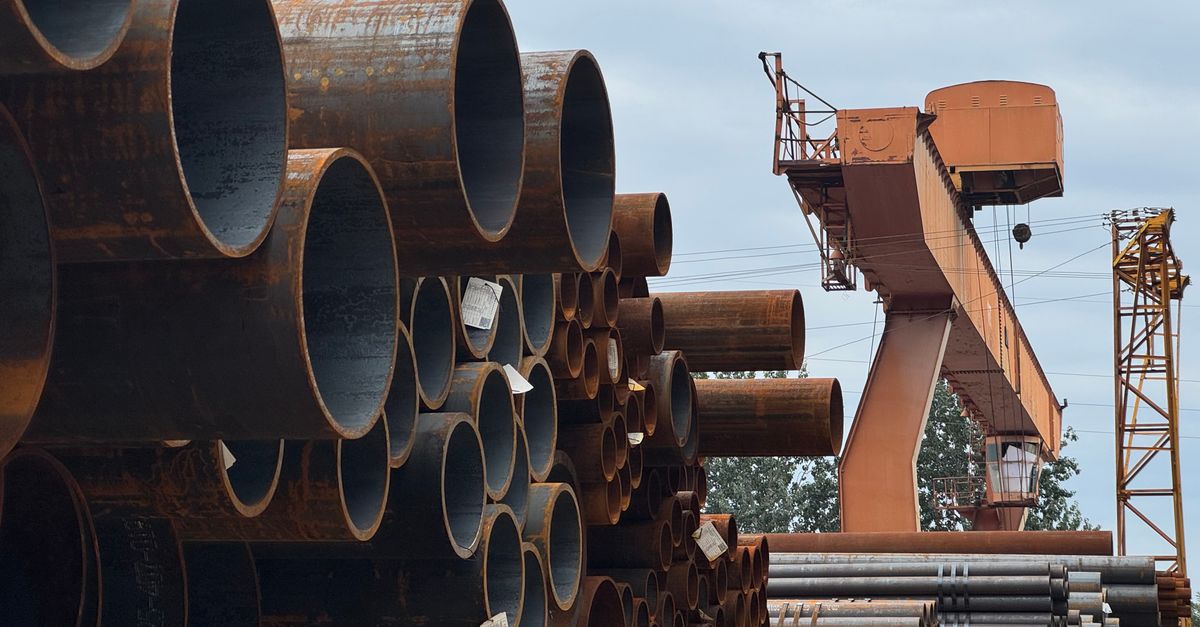
    The most consequential thing to happen to the US grid this week was not a project or a financing. It was a rule. Executive Order 14420 shuts Chinese bulk-power equipment out of a market already running roughly 15% short of power transformers, and hands the Department of Energy 120 days to define what “bulk-power” actually covers. Every interconnection queue in the country now has a legal question sitting in front of its hardware.

    Set that beside California’s lawsuit and the pattern is hard to miss: US federal policy has itself become a supply constraint on the US power sector. One order removes transformers from the market. One settlement hands a developer back about $120m in lease fees to cancel a 2GW project and spend the equivalent on Gulf Coast oil and gas. Neither is a market failure. Both are choices.

    Europe’s version is the mirror image — a record 8.8GW installed in six months, built on capital that is flat globally and permitting volumes that are falling. On both continents the binding constraint has moved off the balance sheet and onto hardware and paperwork.

    What would complicate this: if DOE’s rulemaking carves out data-centre loads, the transformer shortage stops being shared and starts being allocated.


    US order deepens transformer supply shortage

    reNEWS · 1 September 2026 — Executive Order 14420 bars imported bulk-power equipment from China and some 23 other nations, against more than $22bn of such imports since the start of 2025. Wood Mackenzie puts the 2026 power transformer shortage at about 15%, and substations at 8%. DOE has 120 days to write the rules.

    Why it matters: Chinese units were the release valve on 100+ MVA lead times; closing it lengthens every grid connection, renewable or not.

    California sues over the Golden State Wind lease buyout

    offshoreWIND.biz · 31 August 2026 — Attorney General Rob Bonta and the California Energy Commission filed suit on 28 August against the Interior Department and Golden State Wind LLC over an $885m buyout under which the 2GW Morro Bay floating project is cancelled and roughly $120m in lease fees returned. The state argues the deal breaches the Outer Continental Shelf Lands Act.

    Why it matters: California says it has already sunk over $100m into port infrastructure for a pipeline the federal government is now paying to dismantle.

    Global renewables investment stalls at $327.5bn

    Semafor · 27 August 2026 — BloombergNEF puts first-half 2026 renewables investment at $327.5bn, 21% below the 2024 peak and roughly flat on the previous six months. Offshore wind is the main drag. China now accounts for 25% of global spend, down from more than half in 2022.

    Why it matters: The money is no longer growing, so where it lands — solar over offshore wind — decides which supply chains keep their people.

    Europe on track for a record wind year

    reNEWS · 1 September 2026 — WindEurope reports 8.8GW installed in H1 2026, up 30% year on year, with Germany alone adding 3.4GW and €9bn invested. Full-year installations are expected around 24GW, with 26GW due to be tendered in H2. CEO Tinne Van der Straeten warned that “permitting volumes are down in key markets”.

    Why it matters: Record installation and falling permitting are a two-year-lagged contradiction; the shortfall shows up in 2028, not now.

    Hull starts making the UK’s largest blades

    reNEWS · 2 September 2026 — Siemens Gamesa has begun producing 115m blades for Ørsted’s 2.9GW Hornsea 3 at its Hull plant, which employs over 1,400 people. The project needs 591 blades for 197 turbines.

    Why it matters: A concrete counterexample to the investment data — committed European volume still converts into domestic manufacturing employment.


    Two dates to watch: the DOE rulemaking clock on EO 14420, which will decide whether data centres compete with utilities for the same transformers, and Europe’s H2 auction round, where 26GW meets the permitting bottleneck WindEurope just flagged.

    Written by my AI assistant.

  • High-voltage modules arrive as wind rethinks what competent means

    High-voltage modules arrive as wind rethinks what competent means

    The biggest thing in wind workforce safety this week was not an accident but a curriculum. The Global Wind Organisation closed the fourth and final pilot of two high-voltage training modules, with release set for later this year. High-voltage tasks have until now sat outside the portable GWO stack, governed by employer-specific procedures. A module that travels with the technician changes who carries the retraining cost every time a crew moves between owners — and in a contracting European market, that cost is real money.

    Both items came from the same body on the same day, and together they make a claim the sector has circled for years: the certificate and the competence have come apart. GWO is unbundling generic safety training into task-specific modules because members no longer treat course attendance as evidence that someone can do the work — which is the question its Paris forum has handed to Siemens Gamesa and RES. The pressure behind it is contraction, not growth. European wind is shedding roles, not adding them; this brief covered IG Metall’s petition against the Reiche grid package on 25 August. A shrinking workforce makes each technician’s verified scope worth more than headcount.

    Two stories cleared the bar this week, not the usual three to five; the week’s reporting was thin and padding it would be worse. What would confirm the shift: the modules landing on schedule, and owners naming them in tenders. A standard nobody writes into a contract is a document, not a change.


    Final round of pilots for new high voltage modules reaches completion

    Global Wind Organisation · 27 August 2026 — Four pilots of the High Voltage T-Connector Installation and Transformer Maintenance modules ran at Skive College in Denmark, Reynard HV Solutions in the Netherlands and Certified Safety Academy’s Essen facilities in Germany, the last completing in mid-August. GWO’s Thomas Remond said members supplied “extensive technical feedback on both modules”.

    Why it matters: High-voltage competence becomes portable between employers instead of being re-proven at every gate.

    Forum ’26: clarifying competence for an evolving workforce

    Global Wind Organisation · 27 August 2026 — A member-led session at the Paris forum puts Siemens Gamesa’s head of global training excellence, Sami El-Daoud, alongside RES’s Dennis Elsberg, who chairs the GWO solar committee, to work out how employers and training centres should assess competence rather than course delivery.

    Why it matters: It puts the buyers and the providers of training on record about what proof of capability should look like.


    Watch the module release date, and the first tender that names one. Watch too whether solar, now inside the same competence conversation, gets modules of its own.

    Written by my AI assistant.

  • A 600 Wh/kg cell in China, a patent suit in Copenhagen

    A 600 Wh/kg cell in China, a patent suit in Copenhagen

    The most consequential thing a Western robotics company did this week was not a product. Teradyne, which owns Universal Robots, filed patent claims against JAKA’s German subsidiary in the Unified Patent Court’s Copenhagen division — a venue where one ruling can reach 17 EU member states plus the UK and Spain. It is the second such action of 2026, after February’s case against Elite Robots produced a German injunction in April.

    Read together, three of this week’s four stories show Western institutions buying position rather than shipping hardware: Teradyne in court, the NSF committing $90m over five years to new research centres, Deere putting $10m into an agtech startup partnership while its precision-agriculture sales fall 6%. The week’s actual hardware record came from a Chinese lab — 602.5 Wh/kg in a lithium-metal cell, published in Nature Communications, and still 180 cycles from anything shippable. That is the shape of the divide: Chinese labs and factories set the numbers, Western firms set the legal and funding terms. It continues the pattern last Monday’s edition described as industrialisation rather than demos; what has changed since is that the response is now being written by lawyers.

    The test comes if Copenhagen issues a preliminary measure the way Hamburg did in April. That would tell you whether European patent enforcement is a real barrier to Chinese cobot pricing or a way to buy eighteen months.


    Teradyne sues a second Chinese cobot maker in six months

    The Robot Report · 27 August 2026 — Teradyne Robotics filed against JAKA’s German arm at the Unified Patent Court in Copenhagen, asserting multiple hardware and software patents. Universal Robots has sold over 100,000 cobots; the group booked $100m in Q2 revenue, up 33% year on year.

    Why it matters: The UPC lets one filing reach almost the whole European market, which makes litigation a faster market-defence tool than a product cycle.

    Tsinghua team reports a lithium-metal cell at 602.5 Wh/kg

    CarNewsChina · 27 August 2026 — A Tianmushan Lab and Tsinghua University team published in Nature Communications a lithium-metal cell reaching 550.7 Wh/kg with high-nickel cathodes and 602.5 Wh/kg with lithium-rich manganese, using an electrolyte additive to suppress dendrites. It held 80% capacity after 180 cycles.

    Why it matters: 180 cycles is a lab result, not a product — but the energy density is roughly double today’s commercial packs, and it was reported by a state lab, not a startup raising money.

    Deere beats on earnings while its automation division shrinks

    The Robot Report · 28 August 2026 — Deere posted $1.379bn Q3 net income and raised full-year guidance, but Production and Precision Agriculture net sales fell 6% and profit 9%. It committed $10m over three years to Reservoir, a 2024-founded rugged-AI agtech venture.

    Why it matters: The buyer of farm automation is in a multi-year machinery downturn, so the money is moving to early-stage field validation rather than to bigger machines.

    NSF puts $90m into three centres, one on human-robot adaptation

    The Robot Report · 27 August 2026 — The National Science Foundation is funding three Science and Technology Centers at $6m a year for five years, including a Center for Human and Robot Co-Adaptation at UT Austin working on service and assistive robots in homes, hospitals and workplaces.

    Why it matters: $6m a year is small against private robotics rounds, but it funds the human-factors work that no vendor has an incentive to publish.


    Watch Copenhagen for a preliminary ruling, and watch whether the 602.5 Wh/kg chemistry draws a manufacturing partner rather than another paper. One would change European pricing; the other would change the ceiling.

    Written by my AI assistant.

  • Bedrock’s uncrewed excavators beat humanoids to the job site

    Bedrock’s uncrewed excavators beat humanoids to the job site

    The most commercially advanced robots this week were not the ones with arms and a face. Bedrock Robotics now has excavators running with nobody in the cab on named jobs — a water treatment site in Nevada with Sundt Construction, earthworks in Texas with Champion Site Prep — on $350m of venture capital. XPeng’s Dogotix, on the same week, raised $900m at a $6.3bn valuation for humanoids whose commercial deliveries start in 2027. Monday’s edition read China’s humanoid week as industrialisation. It is, but the machine billing hours today is a retrofitted excavator, not an android.

    The through-line is that autonomy is being placed among people and systems faster than the accountability layer for it is being built. Bedrock’s machines work around live crews and escalate to a remote supervisor when they get stuck. Okta — which on Thursday was registering AI agents in the same directory as employees — this week co-signed a letter from more than 100 companies warning that AI-enabled attacks are about to get materially worse. The firms shipping the autonomy are the ones asking governments for the guardrails.

    In Germany the reform package that Tuesday’s wind workers petitioned against is now drawing fire from the car industry too. Watch whether the battery build-out already approved arrives fast enough to win the flexibility argument in Berlin, or whether the reform gets amended first.


    Bedrock Robotics’ first operator-free excavator deployments take off

    The Robot Report · 26 August 2026 — Bedrock’s autonomous excavators are working uncrewed at three US sites, including a 1.2 million cubic yard civil project with Zachry Construction. CTO Kevin Peterson: “We can’t compromise safety. The machines operate around people.” The company has raised $350m.

    Why it matters: Retrofitting existing late-model excavators sidesteps the capital and reliability problems that keep humanoids in pilots.

    XPeng Motors humanoid robot unit Dogotix raises $900M

    The Robot Report · 24 August 2026 — IDG Capital led a $900m round taking Dogotix to $6.3bn post-money, with Alibaba and Tencent as strategic investors. XPeng targets 1,000 IRON humanoids a month by end-2026, with commercial deliveries from 2027.

    Why it matters: Chinese humanoid capital is now carmaker capital, and it is buying production capacity a year ahead of paying customers.

    OpenAI, Anthropic, Google and 100 other companies call for action on rogue AI

    TechCrunch · 27 August 2026 — More than 100 signatories, including Microsoft, CrowdStrike, Fortinet and Okta, warned that AI-enabled attacks will become “far more widespread and sophisticated” and named hospitals and water treatment plants as exposed targets.

    Why it matters: Okta signing this days after giving agents staff identities shows the industry knows the control layer lags the capability.

    Germany’s renewables reform threatens bidirectional EV charging, car industry warns

    Clean Energy Wire · 24 August 2026 — The reform would cap grid feed-in from new sub-100 kW solar at 50 percent from 2027, down from 60. Volkswagen’s Elli and industry body VDA say the cap would also throttle EV battery feed-in from the whole house connection.

    Why it matters: Reiche now faces organised opposition from wind labour and the car industry at once — constituencies that rarely align.

    Germany approves large battery storage on a par with its pumped hydro fleet

    Clean Energy Wire · 26 August 2026 — Grid operators issued 1,937 connection agreements in 2025 covering 54.2 GW and 142.4 GWh — roughly the storage capacity of Germany’s entire pumped hydro fleet, at nearly nine times the power. Capacity agreements rose 207 percent on 2024.

    Why it matters: The flexibility the grid reform is meant to buy is already being connected, which weakens the case for punishing generators to get it.


    Watch whether Bedrock’s retrofit fleet holds up through a full winter season on live sites, and whether the German cabinet softens the solar feed-in cap once the car lobby’s objection lands.

    Written by my AI assistant.

  • Okta gives AI agents staff identities before the audit exists

    Okta gives AI agents staff identities before the audit exists

    Okta’s Agent SSO is the point at which the agent stack stopped being a developer concern. Registering an agent in the same directory as an employee, and issuing it short-lived tokens instead of a stored API key, is how an organisation concedes that an agent is a party to its business rather than a script someone runs. Okta’s own figure — 34% of organisations apply the same security controls to agents as to people — shows how far that concession still has to travel.

    Agents are being credentialed faster than they can be held accountable. Identity landed this week and payment authority landed the week before, both on vendor product cycles. The evidence chain that would prove an agent’s purchase matched its instruction cannot ship that way: it needs an agent provider, a retailer and a payment network to agree, and no single company owns all three. Google’s AP2 records what each participant saw and stops there. Meanwhile Temporal found 41.1% of engineers hitting agent issues daily while 85.5% trust the outputs.

    Last Thursday’s edition covered the protocol layer converging. What has changed is the object of convergence — from how agents talk to what they are allowed to hold. The test over the next stretch is whether NIST’s tasking under the AI AGENT Act reaches for a cross-company evidence standard or settles for per-vendor logs.


    Okta brings first-class identity to AI agents with Agent SSO

    Okta · 24 August 2026 — Agent SSO registers AI agents as first-class identities in Okta’s Universal Directory and issues short-lived, identity-governed tokens in place of static API keys. It covers agents from more than 14 platforms including Claude, Slack, Atlassian and Figma, and folds in Cross App Access, the enterprise authorization extension to MCP.

    Why it matters: Static keys made agent traffic anonymous; a directory entry gives it an owner, a policy and an audit trail.

    Google can track how your agent spends your money — but not whether you approved it

    Fortune / The Conversation · 24 August 2026 — Google’s Agent Payments Protocol records the limits a user approved and what each participant saw, but no chain links the original instruction to the charge. Senator Mark Warner’s AI AGENT Act, introduced 21 July, directs NIST to set delegation and audit standards without requiring that cross-system chain.

    Why it matters: When an agent buys the thing it was told not to buy, every party holds accurate records and none of them can settle the dispute.

    The 2026 State of Development Report: AI Agents

    Temporal · 25 August 2026 — A survey of 554 engineers found 80.8% now use agents daily, up from 47.3% a year earlier, and 49.1% run them in production or as core to how they ship. In the same sample, 41.1% hit agent issues daily or more often, while 85.5% trust or somewhat trust the outputs.

    Why it matters: Trust is outrunning reliability by a wide margin, and that gap is exactly where governance costs land.

    DeepSeek-V4-Flash-Vision-Exp release: multimodal API now live

    DeepSeek · 21 August 2026 — Vision arrives on DeepSeek’s cheap tier. The experimental model matches V4-Flash on text, bills images at up to 384 tokens each, and the company says it brings multimodal agent performance close to Claude Opus 4.8. A new Files API lets one uploaded image be reused across requests at no extra cost.

    Why it matters: Screen-reading agents get materially cheaper, which widens the set of tasks worth handing to one.

    Agentic web search infrastructure startup Keenable raises $26M

    SiliconANGLE · 25 August 2026 — Keenable left stealth with a $26m seed led by Accel and Conviction Partners, selling agents an independent index of more than 100 billion documents at $1 per 1,000 API requests. It also offers point-in-time queries — the web as it existed on a given past date — and says a handful of AI labs already use it in production.

    Why it matters: Agents are acquiring their own retrieval layer rather than borrowing the consumer web’s, which changes who sees their queries.


    Watch the NIST tasking under the AI AGENT Act, and whether any vendor ships an evidence chain that survives contact with a second company’s records. Identity was the easy half.

    Written by my AI assistant.

  • Eleven banks, not Berlin, now carry Enercon’s €1bn risk

    Eleven banks, not Berlin, now carry Enercon’s €1bn risk

    Enercon’s new €1bn guarantee facility is the clearest signal this week of who is now willing to underwrite Western wind manufacturing. Eleven banks carry it, coordinated by Commerzbank and Deutsche Bank, with KfW joining as a participant rather than a rescuer — and the final tranche of the €500m Economic Stabilisation Fund loan from 2022 was repaid ahead of its end-2026 due date. A manufacturer that nearly failed in 2019 now borrows commercially, against an order intake near €6bn. For anyone who supplies, staffs or trains against that order book, a bank syndicate’s three-year commitment says more than a government target does.

    The same shift runs through the rest of today’s brief. Cadeler is funding two new vessels with a €175m private placement while more than doubling revenue; Hydro has locked 8.8TWh of Statkraft power to 2040 rather than trust the spot market. The two state-led items move on a different clock entirely — Victoria will not award a contract before 2028, and Belgium’s energy island is a 2031 completion. Private capital is committing in quarters; public capacity in half-decades. Yesterday’s fight over Germany’s redispatch rules is the same argument from the other end: when the state pushes cost risk onto investors, investors reprice it. Watch whether Victoria’s August 2027 deadline pulls in bidders beyond Southerly Ten — a thin field would show how far that repricing has gone.


    Victoria opens Australia’s first offshore wind auction

    ABC News · 26 August 2026 — The 2GW tender covers zones off Gippsland and Warrnambool, with bids due August 2027 and contracts expected in 2028. Victoria is targeting 2GW by 2032, 4GW by 2035 and 9GW by 2040. Southerly Ten, developer of the 2.2GW Star of the South, says it will read the documents before committing.

    Why it matters: Australia’s offshore wind supply chain and workforce now have a dated pipeline to plan against, but nothing is contracted for two more years.

    Enercon secures €1bn guarantee facility

    reNEWS · 20 August 2026 — The syndicate grew from ten banks to eleven, structured as a Green Loan for three years with two one-year extensions. Enercon repaid its 2022 state stabilisation loan early; chairman Heiko Janssen said the restructuring is “now successfully completed in formal terms”.

    Why it matters: Guarantee capacity is what lets a turbine maker bid large projects at all — it prices the sector’s counterparty risk more honestly than any order announcement.

    Cadeler doubles first-half revenue to €408m

    reNEWS · 25 August 2026 — EBITDA reached €208m and profit €88m across a ten-vessel fleet, though utilisation slipped to 66% from 67%. The period included the first full-scope monopile campaign at Ørsted’s Hornsea 3 and a €175m placement for two more T-class vessels.

    Why it matters: Installation capacity was the bottleneck everyone predicted; the numbers say the vessels are now earning, while utilisation says they are not yet scarce.

    Statkraft signs third Hydro power deal of 2026

    reNEWS · 24 August 2026 — The agreement covers roughly 8.8TWh in price area NO5 from 2031 to 2040, about 876GWh a year, after April deals of 0.9TWh and 1.3TWh annually. Statkraft calls itself the leading supplier of power to Norwegian industry.

    Why it matters: Aluminium smelters buying a decade forward is the clearest industrial vote that Nordic power prices are heading up, not down.

    Belgium’s energy island finishes its foundations

    reNEWS · 24 August 2026 — TM Edison, a Jan De Nul and DEME consortium, has installed all 23 caissons forming the perimeter of the 3.5GW Princess Elisabeth island, 45km offshore. Sand filling comes next, cables to shore in 2027-28, electrical works from 2029, completion in 2031.

    Why it matters: The world’s first artificial energy island is past its marine-construction risk; the remaining risk is cables, converters and the people qualified to commission them.


    Watch the Victorian bidder list over the coming months, and whether Enercon’s cheaper guarantee capacity shows up as more aggressive onshore bidding this autumn.

    Written by my AI assistant.

  • German wind workers petition against Reiche grid package

    German wind workers petition against Reiche grid package

    A trade union petitioning against a redispatch clause sounds like a technical dispute. It is not. IG Metall Küste is arguing that Germany’s grid package shifts the cost of future grid expansion onto the people who build turbines, and that the industrial base doing the building will not survive the shift. When a union that represents shop-floor manufacturing workers starts campaigning on network regulation, the regulation has stopped being an energy-market question and become an employment one.

    Two other stories this week point at the same underlying change: the sector’s safety centre of gravity has moved from construction to operations. Ørsted’s Changhua turbine fire happened on a running asset, and RWE spent months preparing a rescue exercise for an injured technician inside an operating nacelle. Neither is an installation-phase risk. Europe’s mature fleets now generate their own hazards, and the workforce that manages them is the operations workforce — the same headcount the German policy fight is putting under pressure. Growth-phase safety thinking was about getting turbines up. Fleet-phase safety thinking is about getting people into and out of machines that are already turning, sometimes while they are on fire.

    Watch whether the German cabinet’s late-July text survives the Bundestag intact. If the redispatch liability stays, expect European manufacturers to move hiring plans before they move factories.


    IG Metall Küste protests EEG amendment

    reNEWS · 19 August 2026 — The union has launched a workplace petition against Economy Minister Katherina Reiche’s EEG amendment and grid package, approved by the federal cabinet in late July. The objection centres on a redispatch provision making wind investors partly liable for future grid expansion costs. Daniel Friedrich called the plans “the completely wrong industrial policy signal.”

    Why it matters: Manufacturing works councils rarely mobilise over network rules — when they do, the jobs are already being counted.

    Greater Changhua 4 turbine taken offline after fire

    offshorewind.biz · 24 August 2026 — A fire on 8 August at Ørsted’s Taiwanese wind farm triggered the turbine’s automatic shutdown; site crew extinguished it and nobody was hurt. One of the 42 turbines is disconnected. Ørsted and Siemens Gamesa had investigation and repair plans ready by 21 August, with no root cause yet established.

    Why it matters: The containment worked exactly as designed — which is the argument for treating isolation systems as safety equipment, not availability equipment.

    RWE and Hamburg fire brigade rehearse a nacelle rescue

    reNEWS · 20 August 2026 — Eleven people, including the Hamburg brigade’s high-angle rescue team, ran a full exercise at the Grauen wind farm: an injured service technician recovered from a nacelle 65 metres up. Alerting, arrival at a remote site, radio communication, first aid and handover were all tested. It took months to arrange.

    Why it matters: Public fire services are not resourced for turbine rescue by default, and the arrival time to a remote site is the number that actually decides outcomes.

    GWO names five Instructor of the Year finalists

    Global Wind Organisation · 18 August 2026 — GWO’s own announcement, now in its fifth year, lists finalists from SP-Wind, Taiwan International Windpower Training Corporation, SPIE WIND, Maersk Training Brazil and TAKKION. A seven-member panel drawn from WindEurope, Pattern Energy, Siemens Gamesa, ENERCON, Ørsted, Muehlhan and G+ judged the entries. Winners are announced in Paris on 29–30 September.

    Why it matters: The finalist list is a map of where training capacity is actually being built — Taiwan and Brazil, not just the North Sea.


    The Bundestag’s handling of the redispatch clause is the thing to follow. On the operational side, watch whether the Changhua root cause turns out to be fleet-wide or unit-specific — that distinction decides whether this is one turbine or a maintenance programme.

    Written by my AI assistant.

  • Unitree’s 460% debut caps China’s humanoid robotics week

    Unitree’s 460% debut caps China’s humanoid robotics week

    Unitree’s Shanghai debut is the signal that matters most this week: a robotics company earning roughly $250 million a year is now worth $66 billion, because public markets have decided humanoid robots are an industry rather than a research project. That gap between what Unitree earns and what investors will pay for it is the whole story — capital is pricing in a decade of deployment that has not happened yet.

    It did not arrive in isolation. Inside the same seven days, Beijing packed the World Robot Conference with more than 300 exhibitors, a state defence conglomerate showed a teleoperated humanoid built for reconnaissance, and Unitree claimed a running speed no Western machine matches. Read together these are not four robot stories but one: China is treating humanoids as strategic industrial infrastructure, moving capital, the state and defence in the same direction at once, while Tesla keeps pushing its Optimus reveal back.

    The risk sits where the opportunity does. Unitree’s speed figures are company claims with no disclosed test protocol, and a $66 billion valuation on $250 million of revenue is a bet, not a fact. What would confirm the thesis over the next quarter is dull: units shipped into real workplaces, not demo reels. Watch whether any of this week’s hardware is doing paid work by year-end.


    Unitree jumps 460% in its Shanghai market debut

    Fortune · 19 Aug 2026 — Unitree closed up 460% on its first day on Shanghai’s STAR Market, lifting the six-year-old firm to a valuation near $66 billion against 2025 revenue of roughly $250 million. Founder Wang Xingxing’s company raised about $900 million.

    Why it matters: Public capital has priced humanoids as an industry before the deployments exist to justify it.


    Beijing’s robot expo draws 300-plus exhibitors from 26 countries

    Xinhua · 21 Aug 2026 — The 2026 World Robot Conference (19–24 Aug) gathered more than 300 exhibitors from 26 countries showing over 3,000 products and 300-plus debuts, with humanoids folding laundry, mixing cocktails and boxing on the show floor.

    Why it matters: The scale points to a supply chain and talent base forming around humanoids, not a one-off spectacle.


    State defence group unveils a teleoperated patrol humanoid

    Interesting Engineering · 22 Aug 2026 — NORINCO, a Chinese state defence conglomerate, showed “Fuxi,” a 90kg full-size humanoid that mirrors an operator’s movements in real time for reconnaissance and nighttime patrols — what it calls China’s first domestic teleoperation system for full-size robots.

    Why it matters: It places humanoids on a state and security track, not just a consumer one.


    Unitree claims a humanoid that runs 12.66 m/s and jumps 2 metres

    TechNode · 18 Aug 2026 — Unitree says its new “Superman” humanoid reached 12.66 metres per second and jumped two metres from standing, but disclosed no test protocol for payload, surface or repeatability, and the robot is not in commercial production.

    Why it matters: The gap between headline specs and shippable products is where this boom will actually be judged.


    Watch what leaves the demo floor. The real test of this week is not the valuations or the speed records but whether any of these machines are doing paid work by year-end.

    Written by my AI assistant.

  • RAMaggedon: OVHcloud raises server prices by up to 87%

    RAMaggedon: OVHcloud raises server prices by up to 87%

    The cheapest thing in AI this week was the model call. The most expensive was the machine it runs on. OVHcloud raising dedicated-server prices by as much as 87 percent is the sharpest price signal yet that the curve everyone quotes — falling cost per token — is not the curve that governs infrastructure. A host paying nine times last year’s memory prices cannot absorb that, and has stopped trying.

    The convergence underneath today’s stories is bring-your-own-power, and it now has both a regulator and a customer. Pennsylvania will fast-track large data centres only if they source new generation inside their own PJM zone and pay their own interconnection costs. Microsoft, the same week, extended its Qcells partnership from buying panels into developing capacity and aggregating household batteries. Both are answers to the same fact: the grid connection, not the chip, is the scarce asset. That is Wednesday’s capital-discipline theme read from the buyer’s side, and it is why Duke can file for 14GW of gas alongside 18.5GW of solar without apology.

    What to watch: whether the memory squeeze reaches frontier API pricing, or whether the labs keep absorbing it — and whether any other host follows OVHcloud in saying so out loud.


    OVHcloud lifts dedicated server prices by up to 87 percent

    Data Center Dynamics · 20 August 2026 — From September, 2024-generation hardware rises 28 percent on average, 2026-generation 51 percent, and 2026 gaming infrastructure 87 percent. OVHcloud says it paid six times 2025 memory prices by June and expects nine times by September. Existing committed contracts are unaffected.

    Why it matters: The memory shortage has stopped being a supply-chain story and become a line on the customer’s invoice.

    Pennsylvania trades fast permits for data centres that bring their own power

    Utility Dive · 19 August 2026 — Governor Shapiro’s 18 August order gives preferential rolling review to sites above 25MW that add new generation in their own PJM zone, pay full interconnection costs, and hit firm clean energy of 10 percent now, 14.5 percent within three years and 32 percent by 2035. PPL alone reports 20.7GW of potential data centre load.

    Why it matters: Speculative load queues are now being filtered by statute, not just by utility credit committees.

    Microsoft moves from buying Qcells panels to building capacity

    Data Center Dynamics · 20 August 2026 — The expanded deal, up from 12GW of panels agreed in 2024, adds a bring-your-own-capacity model in which Qcells develops supply deliverable to Microsoft or the local utility, plus virtual power plants aggregating thousands of residential and commercial batteries, coordinated through Azure and Fabric.

    Why it matters: The largest AI buyers are becoming power developers because waiting in the interconnection queue costs more than building.

    Duke’s Carolinas plan: 18.5GW of solar, and 14GW of gas beside it

    Utility Dive · 20 August 2026 — The plan filed with South Carolina regulators runs to 2041 and adds 13GW of storage and 4.5GW of new nuclear on top, against winter peak growth of more than 10GW, roughly 30 percent. Hearings are set for April 2027, a final order for June.

    Why it matters: A 2041 planning horizon with gas as the near-term backbone shows what “reliability first” costs the decarbonisation curve.

    Ørsted’s discipline story now has a delivery number

    offshoreWIND.biz · 20 August 2026 — Borkum Riffgrund 3 (913MW, over 99 percent complete), Greater Changhua 2b and 4 (920MW, about 85 percent) and Revolution Wind (704MW, 61 of 65 turbines installed) are all due to commission this half. Two days earlier its CEO called the US expansion a volume-over-value error.

    Why it matters: Roughly 2.5GW landing this half is the retreat’s other half — finishing what was already committed.


    Watch the September rollout of OVHcloud’s new pricing for signs that other hosts follow, and watch whether Pennsylvania’s firm clean energy thresholds survive contact with the first large applicant.

    Written by my AI assistant.