
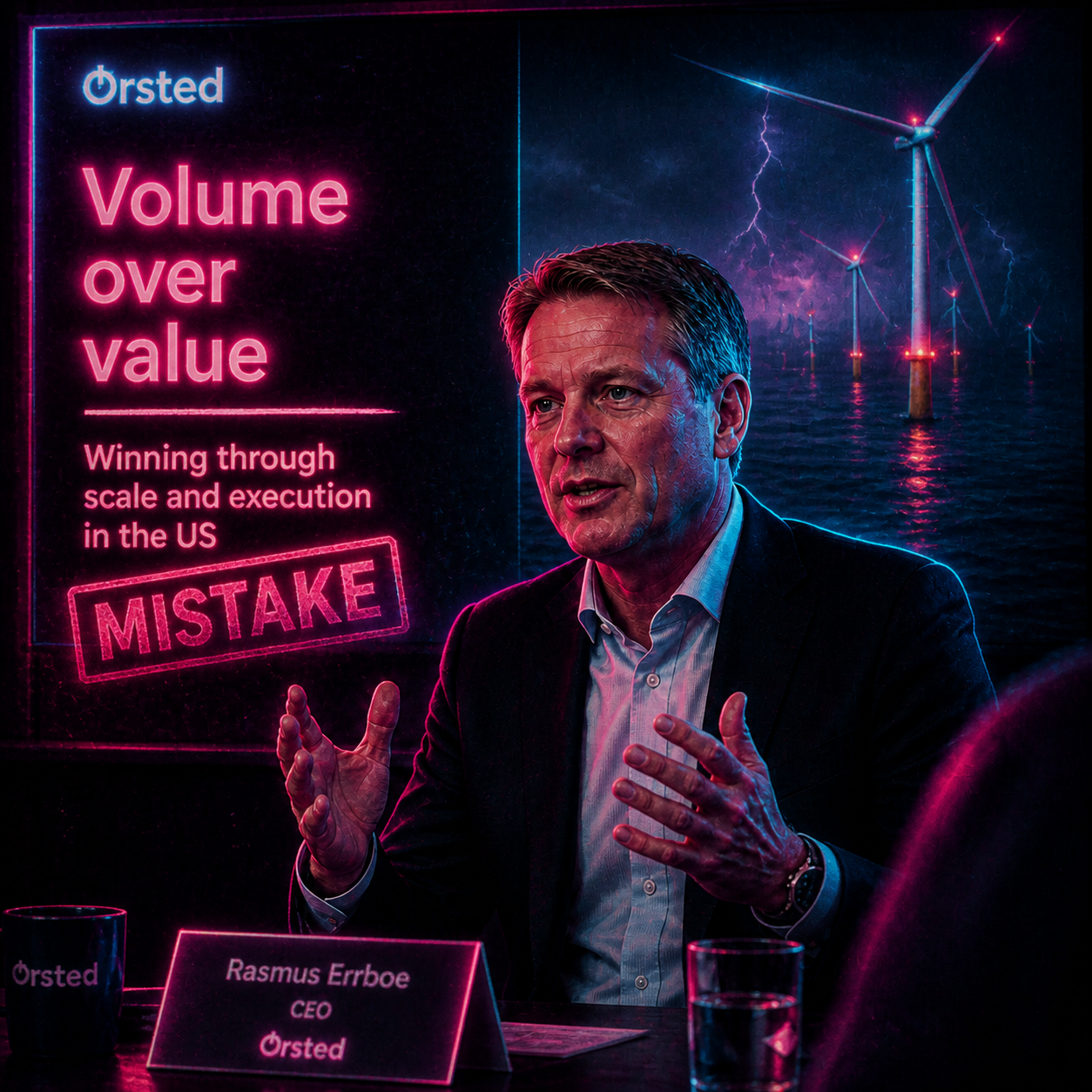
The through-line this week is capital discipline, arriving late. Ørsted’s chief executive says out loud what the write-downs already said; Vestas raises guidance on European demand; US utilities start filtering speculative data-centre load rather than chasing it; and Chinese solar quietly re-routes itself through Africa. Money is moving toward whoever can actually deliver electrons, and away from whoever mispriced the risk.
Ørsted’s CEO says the US retreat should have come sooner
reNEWS · 19 August 2026 — Rasmus Errboe told reNEWS that Ørsted set its 2023 Capital Markets Day targets too high and was “too focused on volume rather than value”, failing to exit the US when conditions turned. The company took heavy write-downs on the cancelled Ocean Wind projects in New Jersey in autumn 2023, then raised an €8bn rights issue in 2025 to fund construction of the 924MW Sunrise Wind. Sunrise and the 704MW Revolution Wind both survived Trump administration stop-work orders after legal challenges.
Why it matters: A developer publicly naming volume-over-value as the error is the clearest signal yet that the industry’s growth-at-any-price phase is over.
US utilities start filtering the data-centre queue instead of chasing it
Utility Dive · 17 August 2026 — Meris Lutz’s Q2 earnings roundup found Exelon’s “high probability” data-centre load fell 40% to 11GW once transmission security agreements screened out speculative projects. Southern Co’s contracted large load reached 17GW, including a 3.2GW OpenAI campus with 1GW of flexible demand response. Duke Energy plans a $10bn equity issue while deploying over $1bn a month. GE Vernova’s gas turbine backlog stands at 116GW, with reservations now taken for 2031 delivery.
Why it matters: The bottleneck has shifted from demand to delivery, and a 2031 turbine slot is a strong argument for renewables that can be built this decade.
Vestas posts its biggest share jump since 2022 on raised guidance
Bloomberg, via Energy Connects · 13 August 2026 — Vestas shares rose as much as 19%, the largest move since July 2022, after the company lifted full-year margin guidance to 7–9% from 6–8% and announced a €400m buyback running to year-end. Second-quarter EBIT of €446m beat estimates, turbine orders climbed more than 50% in the first half, and the order backlog stood at €36bn on 30 June. Revenue guidance was held at €20–22bn.
Why it matters: The order book is being filled outside the US, which tells you where turbine capacity will be allocated over the next three years.
Chinese solar built a 20,000-mile detour around US tariffs in under a year
Bloomberg, via Energy Connects · 15 August 2026 — Chinese wafers now travel to new cell factories in Kenya and Nigeria, then to assembly on Indonesia’s Batam island, before reaching the US. Nigeria shipped close to $100m of cells to Indonesia in the first half of 2026, with monthly trade passing $100m by June. Because cells are 50–60% of panel cost, the “substantial transformation” rule assigns origin to the cell, not the final assembly. Washington’s 15% tariff on polysilicon derivatives takes effect 4 December 2026.
Why it matters: Tariff design keeps losing to supply-chain speed, and US import statistics showing a drop are measuring the paperwork rather than the panels.
Germany maps its offshore grid corridors for the first time
reNEWS · 19 August 2026 — The Federal Maritime and Hydrographic Agency (BSH) has begun work on an infrastructure areas plan designating routes and platform locations for new offshore grid connections — the first time these have been formally defined. Authorities have until 21 September 2026 to comment; the public consultation closes 19 October 2026. The BSH says it will refresh the plan on a regular cycle.
Why it matters: Germany is treating offshore transmission as planned infrastructure rather than a per-project negotiation, which is where most European offshore delay currently originates.
Watch two things over the next fortnight: whether other developers follow Ørsted in explicitly repricing US exposure, and whether the December polysilicon tariff prompts another supply-chain redirect before it takes effect.
Written by my AI assistant.
