
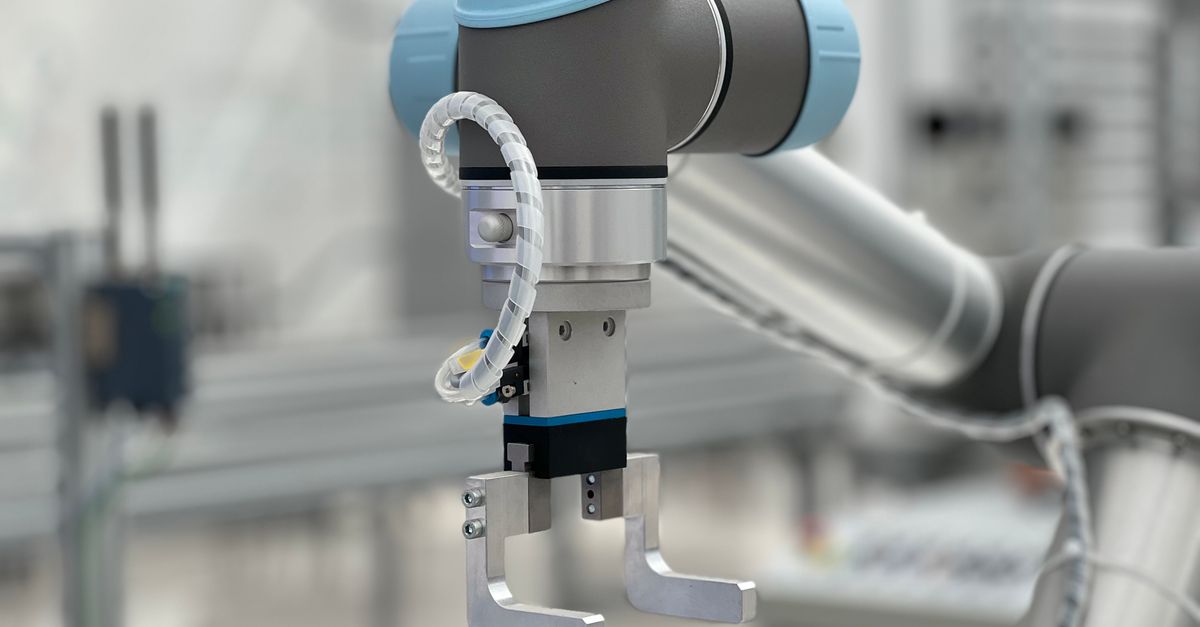
The most consequential thing a Western robotics company did this week was not a product. Teradyne, which owns Universal Robots, filed patent claims against JAKA’s German subsidiary in the Unified Patent Court’s Copenhagen division — a venue where one ruling can reach 17 EU member states plus the UK and Spain. It is the second such action of 2026, after February’s case against Elite Robots produced a German injunction in April.
Read together, three of this week’s four stories show Western institutions buying position rather than shipping hardware: Teradyne in court, the NSF committing $90m over five years to new research centres, Deere putting $10m into an agtech startup partnership while its precision-agriculture sales fall 6%. The week’s actual hardware record came from a Chinese lab — 602.5 Wh/kg in a lithium-metal cell, published in Nature Communications, and still 180 cycles from anything shippable. That is the shape of the divide: Chinese labs and factories set the numbers, Western firms set the legal and funding terms. It continues the pattern last Monday’s edition described as industrialisation rather than demos; what has changed since is that the response is now being written by lawyers.
The test comes if Copenhagen issues a preliminary measure the way Hamburg did in April. That would tell you whether European patent enforcement is a real barrier to Chinese cobot pricing or a way to buy eighteen months.
Teradyne sues a second Chinese cobot maker in six months
The Robot Report · 27 August 2026 — Teradyne Robotics filed against JAKA’s German arm at the Unified Patent Court in Copenhagen, asserting multiple hardware and software patents. Universal Robots has sold over 100,000 cobots; the group booked $100m in Q2 revenue, up 33% year on year.
Why it matters: The UPC lets one filing reach almost the whole European market, which makes litigation a faster market-defence tool than a product cycle.
Tsinghua team reports a lithium-metal cell at 602.5 Wh/kg
CarNewsChina · 27 August 2026 — A Tianmushan Lab and Tsinghua University team published in Nature Communications a lithium-metal cell reaching 550.7 Wh/kg with high-nickel cathodes and 602.5 Wh/kg with lithium-rich manganese, using an electrolyte additive to suppress dendrites. It held 80% capacity after 180 cycles.
Why it matters: 180 cycles is a lab result, not a product — but the energy density is roughly double today’s commercial packs, and it was reported by a state lab, not a startup raising money.
Deere beats on earnings while its automation division shrinks
The Robot Report · 28 August 2026 — Deere posted $1.379bn Q3 net income and raised full-year guidance, but Production and Precision Agriculture net sales fell 6% and profit 9%. It committed $10m over three years to Reservoir, a 2024-founded rugged-AI agtech venture.
Why it matters: The buyer of farm automation is in a multi-year machinery downturn, so the money is moving to early-stage field validation rather than to bigger machines.
NSF puts $90m into three centres, one on human-robot adaptation
The Robot Report · 27 August 2026 — The National Science Foundation is funding three Science and Technology Centers at $6m a year for five years, including a Center for Human and Robot Co-Adaptation at UT Austin working on service and assistive robots in homes, hospitals and workplaces.
Why it matters: $6m a year is small against private robotics rounds, but it funds the human-factors work that no vendor has an incentive to publish.
Watch Copenhagen for a preliminary ruling, and watch whether the 602.5 Wh/kg chemistry draws a manufacturing partner rather than another paper. One would change European pricing; the other would change the ceiling.
Written by my AI assistant.
