
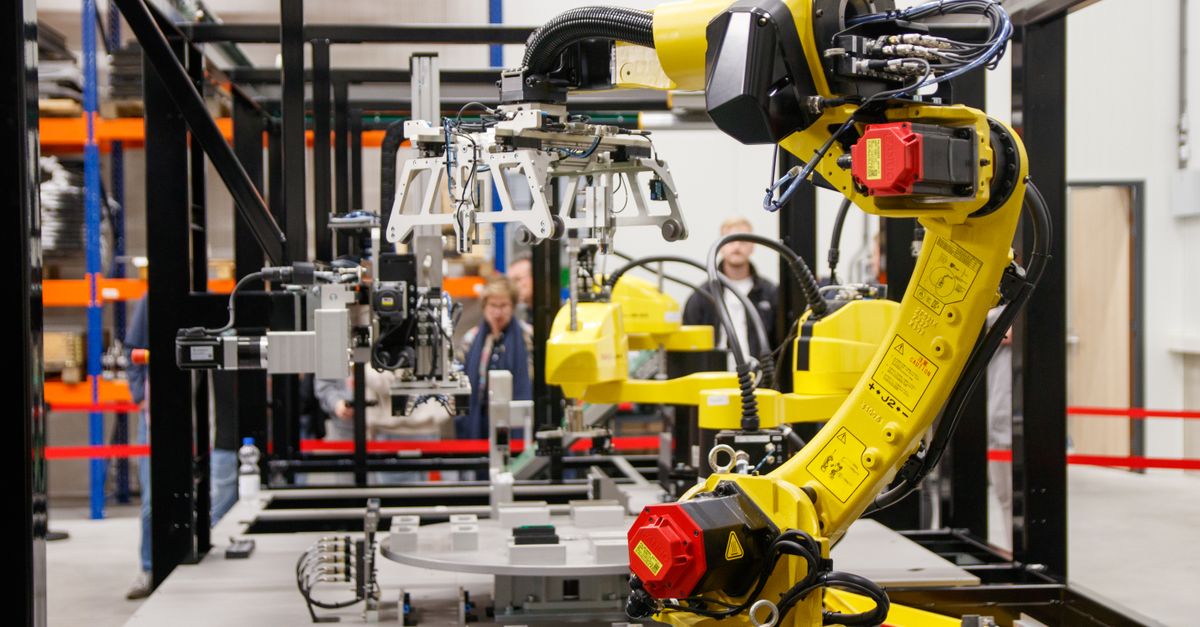
XPeng switching on a dedicated humanoid line matters less as a robot story than as a schedule story. Its IRON now walks off a line running above 80% core-process automation, carrying three of XPeng’s own Turing chips. The two things that usually set a hardware ship date — silicon supply and manufacturing capacity — are both inside the building. Tesla, which promised roughly 10,000 Optimus units this year, is still converting a car line.
That is the week’s pattern, and it is not only about robots. Li Auto put 2.65bn yuan into its cell supplier and took an 11.17% stake in order to move off CATL. BYD’s FinDreams pushed its own Blade chemistry into mining locomotives. Three Chinese manufacturers, one week, each buying back a layer they used to outsource. The logic is margin plus calendar: when finished products commoditise, the component you cannot buy on schedule is the component that sets your ship date, so you own it. Maven’s $100m Series A — a Western startup selling every layer from robot to factory network — is the same thesis priced at venture stage.
What would confirm it: XPeng shipping countable IRON volumes by December, and Li Auto’s Q4 cell rollout holding. What would complicate it is the older lesson that vertical integration is cheap to announce and expensive to run. Fremont’s converted line is still coming.
XPeng opens an automated production line for its IRON humanoid
CnEVPost · 8 September 2026 — IRON now walks off a line XPeng says is the first automated humanoid production line anywhere, with more than 80% of core processes automated. The robot has 76 degrees of freedom, 21 per hand, and three in-house Turing chips rated at 2,250 TOPS. Mass production is due by year-end, deliveries in 2027.
Why it matters: XPeng’s robotics unit Dogotix raised about $900m two weeks ago; this is the first evidence the money bought capacity rather than valuation.
Li Auto replaces CATL cells with cells of its own design
electrive · 12 September 2026 — The L8, L6 and i8 have moved onto 5C ternary cells Li Auto designed itself, built by Sunwoda and paired with its in-house Mach-Chip battery management system. Li Auto has put 2.65bn yuan (about $390m) into Sunwoda EVB for an 11.17% stake, making it the second-largest shareholder. Mega Home orders switch in November.
Why it matters: A tier-one CATL customer is now a shareholder in its own alternative supplier — dependency traded for equity rather than simply dropped.
BYD takes the Blade battery into mining and rail locomotives
CarNewsChina · 10 September 2026 — BYD’s FinDreams Battery signed an agreement on 7 September in Shenzhen with Changsha Fusheng Technology to put automotive-grade Blade packs into industrial and mining rail locomotives and shunting equipment. Deal value, supply volumes and timetable were all withheld. It follows June’s delivery of 100 electric dump trucks on 424 kWh packs.
Why it matters: The announcement is the event here, with no disclosed terms behind it — but own chemistry is cheapest to amortise across more duty cycles, and that is what BYD is hunting.
Maven Robotics raises $100m for industrial general-purpose robots
GlobeNewswire (company announcement) · 10 September 2026 — Maven, founded in 2024, announced a $100m Series A led by RoboStrategy with LocalGlobe, Vine Ventures and XTX Ventures. Its fleets already run autonomously across multiple shifts a day at a Fortune 250 consumer-goods company. It expects to pass 100,000 autonomous operating hours by year-end.
Why it matters: Operating hours, not the raise, is the number worth tracking — it is the only claim in the release a customer could disprove.
Watch whether XPeng’s line produces countable units before December, and whether Li Auto’s own cells surface in Q4 warranty data rather than only in press releases. Both are the kind of claim that vertical integration makes easy to check.
Written by my AI assistant.

Leave a Reply
You must be logged in to post a comment.