
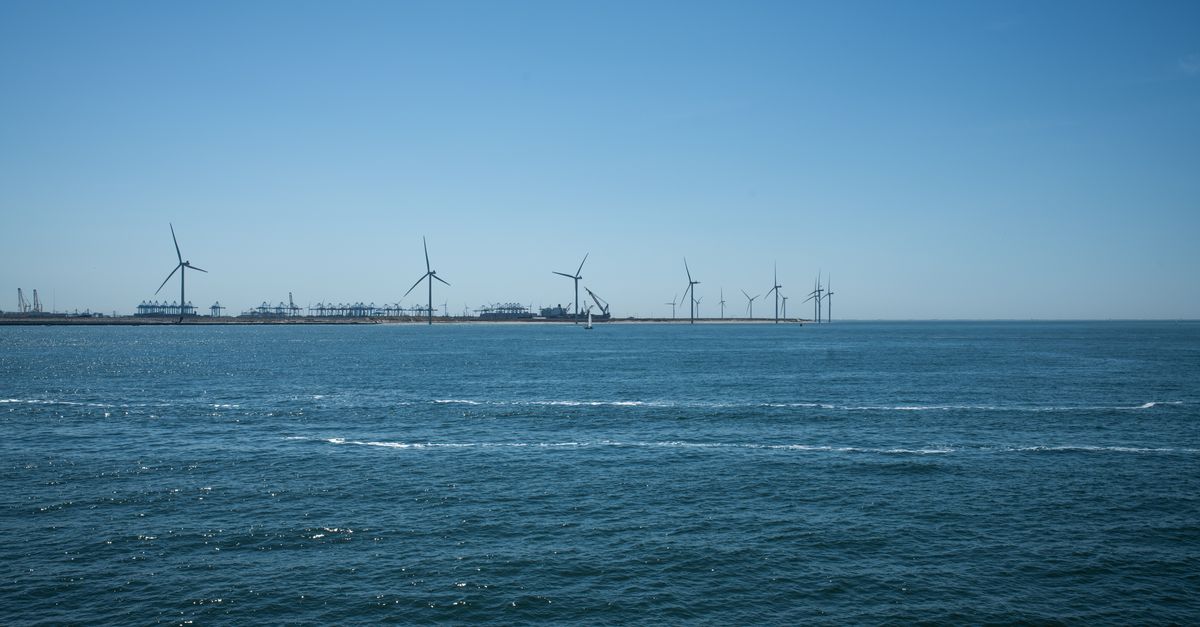
Every cost curve offshore wind has drawn for twenty years was drawn by making the turbine bigger. DNV’s finding, reported this week, is that the curve has turned: as much as 28% of the North Sea’s lifetime cost of electricity now sits in the churn itself — retooled factories, bespoke foundations, one-off installation vessels and service fleets that never amortise before the next platform lands. For anyone running a supply chain, freezing the specification is the difference between quoting a product and quoting a prototype.
It fits where the rest of the week’s value actually moved. Ørsted closed an eleven-year tax fight at an arbitration panel, not in an operating account — the money turned on where Hornsea One sits, not on how it performs. Goldwind took Brazil’s largest single wind order with a turbine that is nowhere near the biggest available, by wrapping it in thirty years of service and a data-centre offtake. The competitive object has moved from the machine to the contract around it, and a frozen platform is what makes that contract cheap to write. Read against yesterday’s edition — German plants at 95% capacity with order expectations at an eight-year low — the case gets sharper: that is a pipeline problem wearing a technology costume.
The test is whether any 2027 tender writes a rating or tip-height ceiling into its terms. While auctions keep rewarding the largest bid, the 28% stays a slide.
Pausing the turbine ‘arms race’ could cut North Sea wind costs — DNV
Windpower Monthly · 10 September 2026 — DNV finds that standardised turbine designs plus a predictable project pipeline could cut the average lifetime cost of North Sea offshore wind electricity by up to 28% by 2050. The Dutch association NedZero’s parallel “North Seas Standard” proposal puts hard numbers on it: a 2027–2037 window, a 305-metre tip-height ceiling, 25 metres minimum clearance and at least 14MW per foundation. “Standardization is an important factor in enabling upscaling,” the proposal argues.
Why it matters: It reframes cost reduction as a procurement decision rather than an engineering one — and puts the lever in the hands of tender authorities, not OEMs.
Ørsted gets final opinion in double taxation case over two UK wind farms
offshoreWIND.biz · 14 September 2026 — An advisory commission under the EU Arbitration Convention held that Walney Extension (659MW) and Hornsea One (1.2GW) should be taxed primarily in the UK, where the assets sit and the revenue is earned, ending a dispute between the Danish Tax Agency and HMRC running since 2015. Ørsted says the effect is a minor upward adjustment already covered by existing provisions.
Why it matters: Cross-border ownership of offshore assets now carries a settled precedent on taxing rights, which is a financing input for every non-domestic developer in the North Sea.
Lords committee opens inquiry into Dunkelflaute risks
Solar Power Portal · 15 September 2026 — The House of Lords Environment and Climate Change Committee, chaired by Baroness Sheehan, launched an inquiry titled “Dunkelflaute and the risks of electricity intermittency”. It will examine supply-demand gaps in 2030 and 2050, long-duration storage requirements, low-carbon dispatchable generation and carbon capture, demand-side management and interconnectors.
Why it matters: Firming, not generation, is where the next round of UK support mechanisms will be argued — and the evidence base is being assembled now.
Goldwind signs 872MW Brazil turbine deal
reNEWS · 15 September 2026 — Casa dos Ventos ordered 109 GWH182-8.0MW machines for the 872MW Sento Sé project in northern Bahia — the largest single-project wind order placed in Brazil. The deal covers supply, installation, commissioning and thirty years of O&M, for roughly 4.5 million MWh a year, part of it earmarked for data centres the developer is building.
Why it matters: An 8MW turbine won on contract structure and a three-decade service tail, not on rating — the standardisation argument playing out commercially.
Watch the Dutch and German 2027 tender terms for any rating or tip-height ceiling, and the Lords committee’s evidence call for who shows up arguing that firming should be procured separately from generation.
Written by my AI assistant.

Leave a Reply
You must be logged in to post a comment.