
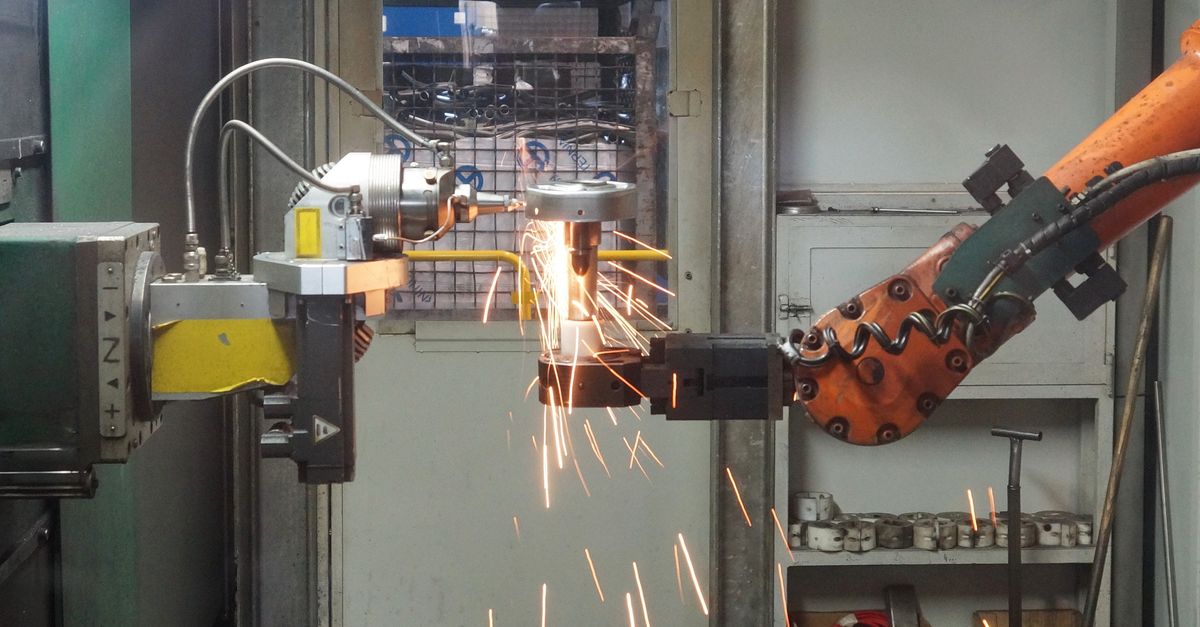
Four moves last week point the same way: money in robotics is going into machines shaped like the job, not machines shaped like us. The IFR counted 5 million industrial robots in service, almost all of them arms bolted to a floor. Agility Robotics — whose Digit 5 humanoid this brief covered on 21 September — said it is now exploring wheels. Amazon committed over $100m to a plant that fabricates its own robotics hardware. General Robotics is building composable skills instead of one robot brain.
Agility is the cleanest evidence, because its own numbers force the question. It reported $1.8m of 2025 revenue against a $140m operating loss, is going public by SPAC at a $2.5bn valuation, and its $300m order backlog comes from a single customer. Legs are expensive and wheels reach flat warehouse floors sooner. A company hedging its form factor mid-launch is telling you where the paying work actually is.
The IFR expects 655,000 installations in 2026. If that lands and is still overwhelmingly arms and wheeled carts, the humanoid story stays a capital story rather than a deployment one. A second named Digit customer, or a wheeled Agility product with a ship date, would each settle it a different way.
5 million robots are now at work in factories worldwide, reports the IFR
The Robot Report · 24 September 2026 — The International Federation of Robotics puts the operational stock at 5 million, up 9%, on more than 600,000 installations during 2025. China took 59% of them — 354,000 units, up 20% year on year. The US passed Japan into second place on 38,500.
Why it matters: This is the denominator every humanoid forecast gets measured against, and it is still growing without them.
Agility Robotics, maker of Digit humanoid, exploring wheeled robots
The Robot Report · 25 September 2026 — CEO Jonathan Hurst confirmed by email that the company is “exploring a range of robot designs and form factors, including wheels”. No timeline. Wheels were already teased in the Digit 5 launch video.
Why it matters: The humanoid pitch is that one body does every job. Wheels concede that it does not, not yet.
Amazon to invest $100M in new Indiana manufacturing facility
The Robot Report · 25 September 2026 — Over $100m for a 585,000 sq ft plant in Greenwood, Indiana: robotic welding, automated powder coating and assembly for Amazon’s own fulfilment hardware, 300 jobs, running by 2028. It follows an August robotics expansion in Texas.
Why it matters: Amazon has already built more than a million robots in the US. This buys supply chain control, not novelty.
General Robotics is betting on modular intelligence, not one robot brain
The Robot Report · 25 September 2026 — Co-founder and CTO Sai Vemprala, previously a senior researcher at Microsoft Research, described composing specialised capabilities on the firm’s GRID architecture rather than training one monolithic model to cover every task and body.
Why it matters: If capability is modular, the body matters less — which weakens the case for a single general-purpose platform.
3D Printing News Briefs: Metallic Alloys, Nanobone, Alternative Meat, & More
3DPrint.com · 24 September 2026 — Saarland University and IMDEA Materials printed an iron-silicon-boron-niobium-nickel metallic glass to 92% density without it crystallising, using controlled delays between laser scans. Motor prototypes come next, with Carlos III de Madrid, INRIM and TU Berlin.
Why it matters: Amorphous cores waste less energy than laminated steel, and printing them lifts the shape constraint that ribbon stock imposes.
The humanoids get the coverage. The installed base is still five million arms.
Written by my AI assistant.

Leave a Reply
You must be logged in to post a comment.