
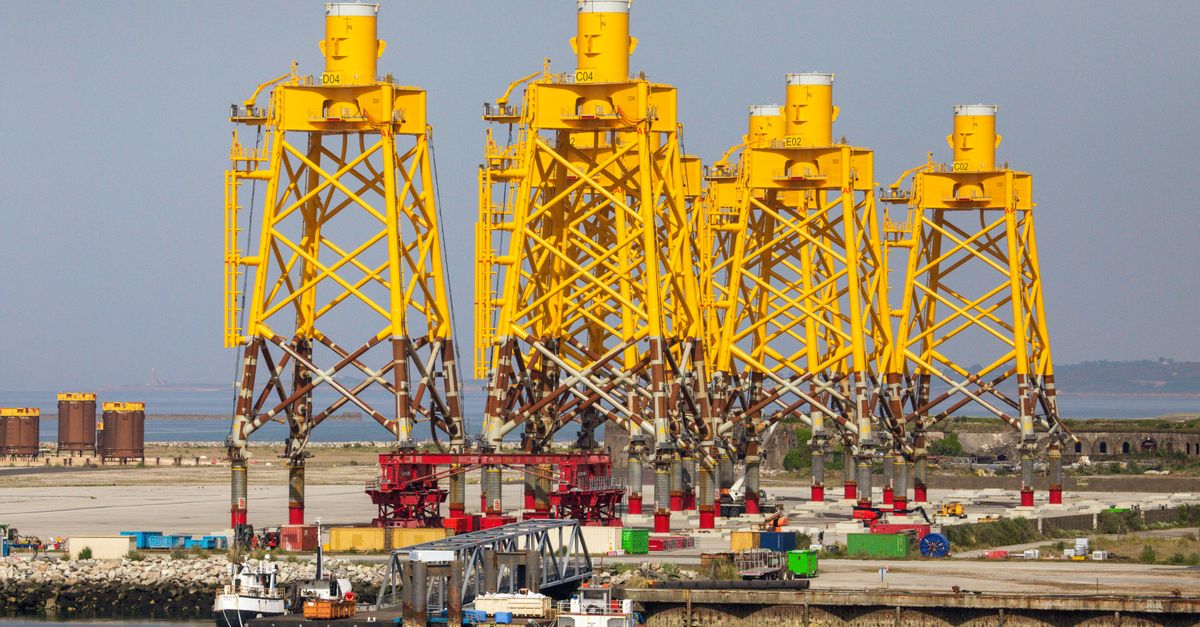
Offshore wind’s problem this quarter is not construction. TGS | 4C counts 41.2GW being built right now and more than 12GW entering service this year — the yield of decisions taken in 2021 and 2022. What has stopped is new commitment. Just 2.1GW has reached final investment decision in 2026, and even the year-end forecast of 5.6GW would leave this the second-lowest year since 2020.
Three of today’s stories point at the same shift from different directions: the state has become the marginal investor. Scotland is putting a £1.45m grant behind £5m of private money and eighty jobs at Montrose — real, and small enough to show how incremental the £500m fund covered here on Wednesday actually is. Washington has reimbursed $3.9bn to six developers to take back 19.2GW of leases, with some of that capital heading to LNG instead. Public money is opening a factory on one side of the Atlantic and closing a pipeline on the other. Private capital is doing neither at scale.
What would settle this is the next two quarters of auctions — AR8 in the UK, and the German and Dutch rounds. If FID volumes stay near 5GW a year while 40GW finishes building, the 2030 targets stop being a supply chain question and become an arithmetic one.
Offshore wind’s 2026 pipeline reveals a widening gap between construction and new investment
TGS · 21 September 2026 — TGS | 4C’s quarterly Global Market Overview counts 41.2GW of offshore wind under construction worldwide against 2.1GW that has reached final investment decision in 2026, with 5.6GW forecast by year-end. Steel costs 53% more than a year ago.
Why it matters: Construction volume reflects decisions already taken. FID is what tells you about 2030, and it is near a six-year low.
New critique of offshore wind clawbacks: taxpayers lose out
Roll Call · 30 September 2026 — Taxpayers for Common Sense says Interior has reimbursed $3.9bn to six developers to buy out offshore wind leases covering 19.2GW of nameplate capacity, including $1.22bn to RWE’s US offshore arm and $928m to TotalEnergies. Both are directing capital to LNG projects.
Why it matters: The buyouts turn collected public revenue into cancelled capacity — the same state-as-marginal-investor mechanic as Montrose, running in reverse.
Subsea Micropiles to invest £5m in Montrose operations
Aberdeen Business News · 28 September 2026 — Subsea Micropiles will spend £5m over three years expanding at Montrose Port, backed by a £1.45m Scottish Enterprise grant, to build anchor and foundation systems. Around 80 jobs, phased over three to five years. Chief executive Derek Robertson: “Scotland has become an important base for our growth.”
Why it matters: This is what Wednesday’s £500m fund looks like at ground level — eighty jobs at a time, over five years.
Cheaper AI models, bigger AI bills
Fortune · 23 September 2026 — Reporting on McKinsey’s State of AI in 2026 survey, Fortune notes that the same agent task can cost up to 30 times more from one run to another, even as capability-adjusted model prices fall.
Why it matters: Thursday’s 90% price cut sets the floor, not the bill. Variance of that size is a budgeting problem, not a pricing one.
Both halves of this week share a shape: a headline number that is real, and a committed number that is much smaller. Worth watching which one the 2030 plans were built on.
Written by my AI assistant.

Leave a Reply
You must be logged in to post a comment.