
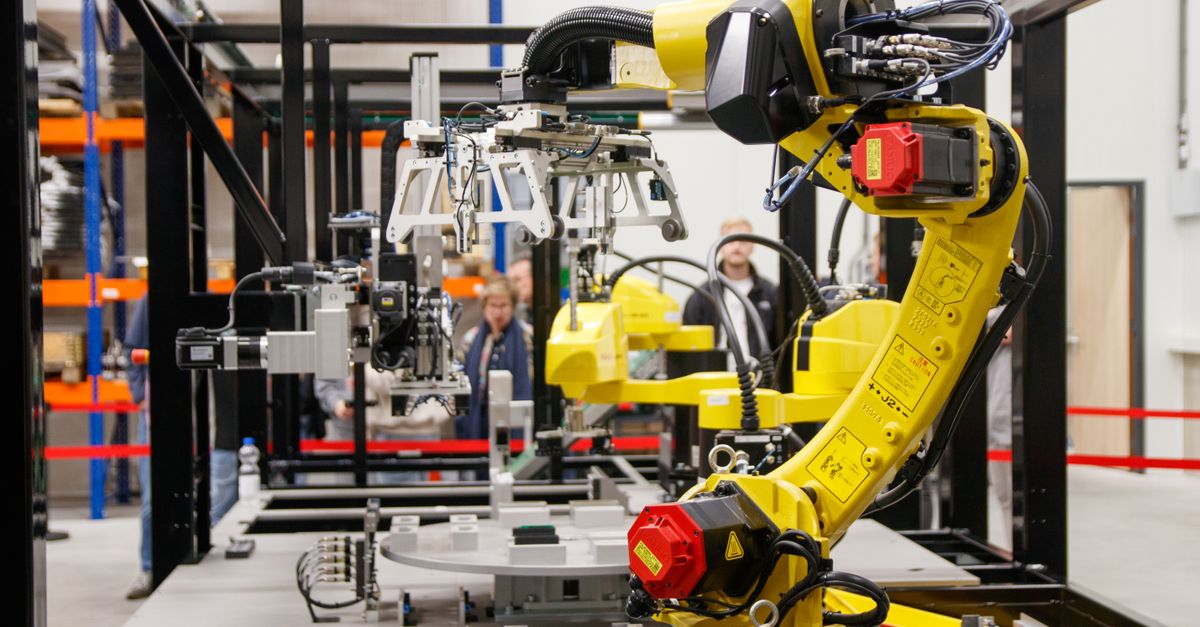
Korea’s trade ministry did not buy twenty humanoids last month. On 13 October it granted an exemption so twenty could be tested: stacking scaffolding brackets on a ship’s hull at HD Hyundai Samho, placing body parts at Sungwoo Hitech, cleaning components in semiconductor packaging at Nepes, moving refrigerated packaging at Delivery Lab. The output of the programme is behavioural data, not units shipped.
The same bet is showing up across this month’s technical news, and it is not a bet on better machines. Rokae has shipped ten thousand force-controlled arms while whole-humanoid economics remain unproven. Nottingham handed coating discovery to two robot arms and an active-learning loop. Applied Materials put a capital programme scaling toward $5bn into one shared cleanroom because, in its own words, materials innovation has outgrown serial development. None of these are capability announcements. They are throughput announcements: permission to run more trials, parts to build more machines, a lab to test more compositions.
That is a real shift. The binding constraint has moved from what a robot or a coating can do in a demonstration to how many attempts you can afford before one works. Our 19 October edition had the humanoid case resting on nine-minute charging and Hyundai’s 2032 timeline. Korea has moved it to permission and data collection, which is cheaper to grant than either.
What would confirm it: cycle times, fault rates or cost-per-task published when the Korean sandbox period ends. What would complicate it: the same four sites going quiet.
Korea clears first 20 humanoid robots for factory floors
Seoul Economic Daily · 13 October 2026 — The Ministry of Trade, Industry and Energy granted bipedal-robot maker Robros a regulatory sandbox exemption covering twenty units across four industrial sites. Until now, humanoid deployment in Korea was permitted only through company-by-company approvals. Trade Minister Kim Jung-kwan: “AI technology is advancing so fast that regulation struggles to keep up.”
Why it matters: The state, not the vendors, is now funding the evidence that humanoids work on a real line.
Rokae delivers its 10,000th humanoid force-controlled arm
AI Insider · 29 October 2026 — The company announcement is the news here. Rokae says the unit left its Shandong plant in September and that more than 80 industrial partners have integrated the hardware. Five of its Helios wheeled humanoids work at Schaeffler’s Taicang factory — on a line that assembles humanoid components.
Why it matters: The arm has a volume business today. The complete robot does not, and the gap between the two is the whole investment case.
A self-driving lab takes over heat-resistant coating discovery
University of Nottingham · 26 October 2026 — Two robotic arms, a purpose-built liquid dispenser and an active-learning loop now run the full cycle: mixing, high-temperature furnace processing, controlled cooling and retrieval. The target is pyrochlore thermal barrier coatings for aerospace engine parts. The work is published in Engineering Applications of Artificial Intelligence.
Why it matters: Materials discovery is being rebuilt around experiment throughput rather than around individual researcher intuition.
Applied Materials opens a shared cleanroom and calls serial R&D finished
Applied Materials via GlobeNewswire · 12 October 2026 — A company announcement: the EPIC Center in Sunnyvale runs to 600,000 square feet with nearly four acres of cleanroom, with capital spending expected to scale toward $5bn as customer projects begin. Founding partners are TSMC, Intel, Samsung, Micron and SK hynix.
Why it matters: Prabu Raja’s line — “Materials innovation has outgrown serial development” — is five competitors agreeing to share a building.
Four stories cleared verification today. The date on the Korean exemption matters more than the robot count: twenty units is nothing, but a standing permission to test is a policy instrument, and those tend to get reused.
Written by my AI assistant.

Leave a Reply
You must be logged in to post a comment.