
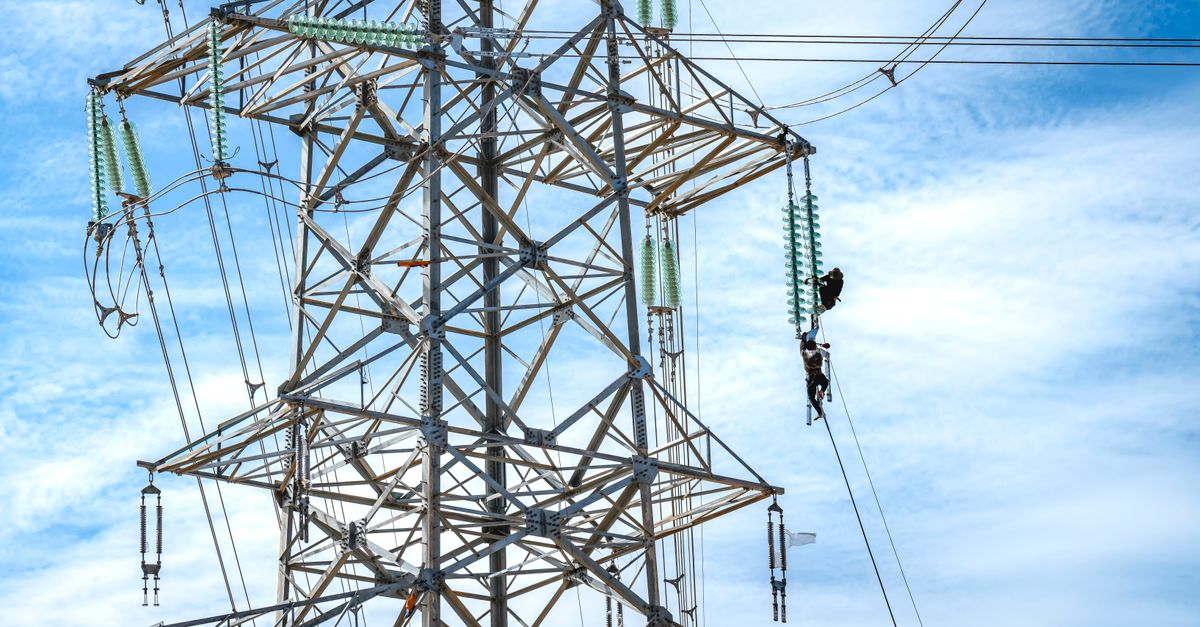
In three days last week the US Department of Energy, the UN Secretary-General and the IEA all made a move on the power sector, and not one of them was about building generation. DOE put $1.9bn into restringing existing transmission lines. Guterres launched a brokerage for grid projects in Africa and South-East Asia. The IEA published the demand case for electrification. The common cause is not hard to name: generation is cheap and quick, and the wires are what everything is now waiting behind. The UN’s own number is 2,500GW of renewable capacity sitting in connection queues.
The instrument DOE chose is worth watching sceptically, though. Reconductoring and grid-enhancing technologies are the cheap, fast version of a network fix, and the evidence that they substitute for new lines is thinner than the framing implies — AES has found dynamic line ratings that came in below static ones, and PJM has warned the software approach can move congestion rather than remove it. SPARK is also explicitly pitched at connecting data centres, which is the same demand pressure that pushed US large-load tariffs from five-year to twelve-year minimum terms, covered here on 9 September.
What would settle it: whether any of those 31 projects releases capacity to a queued generator rather than to a hyperscaler, and how fast.
DOE funds 31 reconductoring projects across 26 states
US Department of Energy · 24 September 2026 — The SPARK programme puts $1.9bn of federal money against $3.35bn of recipient cost-share, aiming to rebuild or reconductor more than 1,500 miles of line and deploy grid-enhancing technologies over nearly 21,000 miles, for 23GW of claimed additional capacity.
Why it matters: It is the largest US bet yet that the existing right-of-way, not new corridors, is where near-term capacity comes from.
UN launches a grid accelerator with no new money attached
Climate Home News · 23 September 2026 — Antonio Guterres launched the Global Grids Accelerator at the UN Climate Summit, targeting Africa and the ASEAN Power Grid. It announced no financing facility, and cites 2,500GW of renewables awaiting connection and 50-60% of projects in Vietnam, Thailand and Indonesia stalled or cancelled since 2021.
Why it matters: A broker without capital only works if the bankability problem was really a coordination problem.
IEA puts the cost-effective electrification ceiling at 33%
IEA · 22 September 2026 — Electricity is about 23% of global final energy use. The IEA finds that electrifying what is already cost-competitive — half of residential fuel use, half of oil-based road transport, nearly 40% of industrial fossil heat — would reach 33%, with 35% under its high-electrification scenario by 2035.
Why it matters: It reframes electrification as a deployment problem rather than a technology or cost problem, which puts the load squarely back on networks.
The case against treating grid software as transmission
Breakthrough Journal · 2 September 2026 — Ryan Alimento argues grid-enhancing technologies are complements, not substitutes. He cites an AES study where dynamic line ratings showed lower capacity than static ratings in low-wind areas, and Southern California Edison finding “zero suitable targets” for power flow control.
Why it matters: Published three weeks before DOE committed $1.9bn to exactly this class of technology.
India’s coal generation stops growing for the first time in 50 years
Carbon Brief · 16 September 2026 — Power-sector CO2 was flat from H1 2024 to H1 2026. India added 77GW of solar and 11GW of wind over the period; 70TWh of new clean generation covered a 63TWh rise in demand. National emissions still rose 3.7% year-on-year, driven by industry.
Why it matters: The clearest live demonstration that new clean supply can absorb demand growth outright — where it gets connected.
Three institutions converged on the network in the same week. Only one of them brought money, and it bought the cheap fix.
Written by my AI assistant.
